About Me

My photo
Delray Beach, FL, Westport, MA, United States
Undergraduate degree, Colby College; MA in English, Columbia Teacher's College; former high school English teacher in three states; former owner of interior design co. with MA from R.I. School of Design. Barking Cat Books published my first book in 2009 titled, MINOR LEAGUE MOM: A MOTHER'S JOURNEY THROUGH THE RED SOX FARM TEAMS. My humorous manuscript titled ELDERLY PARENTS WITH ALL THEIR MARBLES: A SURVIVAL GUIDE FOR THE KIDS was published in June, 2014. In 2015 A SURVIVAL GUIDE won a gold medal in the self-help category at the Florida Authors & Publishers Association conference. In 2018 Barking Cat Books published my SURVIVING YOUR DREAM VACATION: 75 RULES TO KEEP YOUR COMPANION TALKING TO YOU ON THE ROAD. See website By CLICKING HERE.
Showing posts with label France. Show all posts

Tuesday, September 11, 2018

Our Guide through the Basque Country, 2018

     In "The Keys Behind Treasured Stops" (NY Times Travel Section, August 19, 2018, p.4), Elaine Glusac writes, "... a great trip should involve a journey, embody a culture, and script a story to tell later." Here is one story of our guide through the Basque Country of France and Spain.


     On a previous trip to France, we'd hired Christian Mayer to take us from Paris through Monet's Giverny and the villages of Honfleur and Bayeux (where the 230-foot-long tapestry resides depicting Norman events leading to William, Duke of Normandy's, conquest of England in 1066). Christian drove us to Deauville, with its grand casino, racetrack, and wide beach, as well as to Ste. Mere-Eglise, where paratrooper John Steele from the 82nd Airborne remained suspended when his parachute got caught in the church steeple on D-Day, 1944. Unlike the depiction in "The Longest Day," the American was taken prisoner and escaped to become a town hero. From Ste. Mere-Eglise where we stayed,  we toured the beaches, cemeteries, and museums of World War II on the Normandy coast.
Bayeux, France


Honfleur, France


Monet's Giverny Lily Pond and House (in background)

Crater Bombardment on Omaha Beach, France
Recreation of parachutist John Steele hanging from church steeple in Ste. Mere-Eglise, Fr., on D-Day


     Our guide, Christian, was an American from New Mexico who'd married a French woman and relocated outside Paris. In June, 2018, we returned to France and hired Christian to guide us from Biarritz, on the Atlantic, through the Basque country of France and Spain in the Pyrenees, close to Christian's home where he and his wife were raising their family.
Christian Mayer with Charley at Chartres Cathedral, France, 2011
     Christian's father's family was French; his mother's family was Austrian. We learned his family story during our rides through the mountains between France and Spain - one of the many personal souvenirs we've collected during our travels.
     Since the name "Mayer" sounded Jewish to the Germans during the Occupation of France, his paternal grandparents were forced to sell their mountain camp for children and relocate in Nice, where they opened a restaurant. They moved on to settle in Cap d'Antibes, where they operated a hotel. Christian's grandmother ran messages to the resistance in a pump tube on her bike. His grandfather was arrested, charged with an "act of resistance," while his granduncle was executed by the S.S. Christian's grandmother washed the linens of a Frenchman sympathetic to the Germans and got her husband released.
     "My grandmother didn't want her two sons drafted into the War," Christian told us. "My uncle Jean and my dad 'Dadou' were members of the French National ski team, so the family was able to make its way to Paris. I remember my dad telling me they heard Allied bombers overhead for an hour before they actually bombed. He described the German revolving machine guns that enforced curfews in the City.
     "A German with the code name 'Ernie Blake' had been a double agent and was rewarded by the U.S. with cheap forest land in New Mexico.There he built a ski lodge and the St. Bernard Hotel in what became Taos Ski Valley. He advertised for a ski instructor/hotel operator. 'Dadou' was the only one who answered the ad. Eventually dad was able to bring his brother Jean, also a ski instructor in France, and the rest of the family to Taos. The two brothers pooled their money and their parents added their savings to become owners of the St. Bernard Hotel. It's still there.
     "My mother was from Vienna and answered an ad for an 'au pere' in Taos, where her brother was the ski lift engineer. That's where my parents met. Eventually dad and uncle Jean split and dad bought out Jean's portion of the St. Bernard. Uncle Jean opened the Eidelweis Hotel there. The two hotels stood side-by-side.
     "My cousins and I grew up on skis and snowboards, despite the fact that snowboards were forbidden on the slopes of Taos at the time. We used to sneak down to the weekly concerts in the hotels and hung out with the musicians. I guess that's how I got started playing the sax. I formed my own band and started touring Europe."
     "How did you become enamored with the sea if you grew up in New Mexico?" I asked Christian.
     "Well, my dad was a U.S. citizen and after my parents divorced, he moved to Hawaii. I loved to surf out there."
     "Did your mother become a citizen?"
     "Well, mom was a proud Austrian. She refused to apply till after the divorce, when she had to go to work."

Monday, August 20, 2018

Travelogue, French Basque Country, 2018

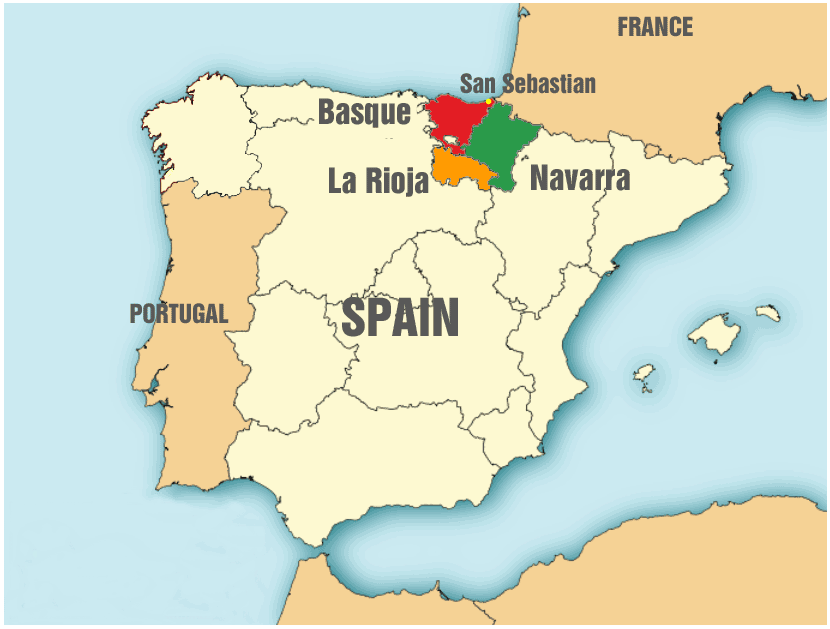
     We arrived in Biarritz, France, in June, 2018, for a trip through the Basque Country of France and Spain. Our travels would take us from Biarritz on the Atlantic through the Pyrenees to the city of San Sebastian, Spain, on the coast and down to Bilbao.
     The Basque region of France and Spain ("Pays Basque Francais" in French and "Pais Vasco" in Spanish) is a culture apart. Unrelated to any other tongue, Euskera (the Basque language) is spoken in the region bordering France and Spain and much of Navarra (the area of Spain which includes Pamplona). To an untrained ear, it sounds most like the Hungarian language. The town of "San Sebastian" in standard Castilian Spanish becomes "Donostia" in Basque, for example; "Vitoria" becomes "Gasteiz" in Basque. Road signs are in both standard Spanish and Basque.
     The origin of the Basques is a mystery, but mainstream archaeology classifies them as offspring of migrants who first populated the area 35,000 years ago. Fiercely independent, they cut deals with the Romans to respect Basque law and tradition. A long succession of monarchs followed who abided by these promises. In 1876 the Spanish crown abrogated these fueros (promises), setting off the first stirrings of Basque separatism.
     Although the Basque Country is largely self-governing under modern Spanish and European Union law, a popular political movement for full separation from Spain (and to a lesser extent France) remains. Unfortunately, Basque separatism today is best known for the terrorist acts by the group ETA, whose last major attack was the Madrid airport bombing in 2006. While we traveled through the region in June, 2018, we saw no political agitation of any kind.
     Our guide through the region was Christian Mayer, an American who married a French woman and relocated, following his heart. We first met him in Paris, when he drove us through the Normandy beaches and down across the Loire Valley. Subsequently he and his wife moved to the Dordogne region, just north of Basque Country, to raise their daughters.
     Christian picked us up at our hotel in Biarritz and we drove north along the French coast through Bayonne before heading southeast toward the town of Sare inland. In Sare a gear-wheeled train climbs thirty-five minutes up the western-most peak of the Pyrennes, affording a spectacular 360-degree view of the seven Basque provinces across the mountains and along the Atlantic. The Grotto of Sare is nearby, a large cave inhabited in prehistoric times (with hieroglyphics) and discovered at the end of the 19th Century under the exploration of Edouard-Alfred Martel.
Hieroglyphics in prehistoric cave, Sare, Fr.


     We stopped next in Ainhoa, a typical French Basque town in the foothills with shutters painted the red and green of the Basque flag. Names on the headstones in the cemetery were spelled in Basque. The Place du Fronton was central, featuring a large red wall against which two players hit a ball in the sport of Pelote (similar to Jai Alai). Each town we visited revolved around the fronton. Red chili peppers hung to dry on the outside of the houses.
Ainhoa, France    
Above-the-ground cemetery with inscriptions in Basque, Ainhoa, Fr.

     St. Jean Pied de Port ("St. John at the Foot of the Pass") was a lovely stop for lunch along the River Nive. The town stands at the base of the Roncevaux Pass through the Pyrennes and is the pilgrims' starting point on the French side before the arduous mountain crossing during their Camino de Santiago pilgrimage.
     The Camino de Santiago pilgrimage is a network of pilgrims' paths to the shrine of apostle Saint James, said to be buried in the Cathedral in Compostela in the northwestern-most area of Spain. The pilgrims carry a document purchased for a few euros through their church or the National St. James Organization which gives them access to inexpensive, sometimes free, accommodations marked by a seashell. The document serves as proof that the journey was accomplished according to an official route of towns along the trail. In 2017 there were 300,000 pilgrims who made the trek, following the sign of the seashell. The City Gate in St. Jean Pied de Port was added by UNESCO as a World Heritage site.
St. John Pied-de-Port, Fr.
 
Street scene, St. John Pied-de-Port, Fr.
Note the seashell symbol above the door.


Outdoor restaurant above waterfall, St. John Pied-de-Port, Fr.


Street scene, St. John Pied-de-Port, Fr.


Pilgrims' portal now a UNESCO World Heritage Site, St. John Pied-de-Port, Fr.
     Our last stop on the French side was St. Jean de Luz, a larger bustling town with pedestrian main street, whose shopkeepers announced their professions outside in sculpture, similar to towns in Austria. The Cathedral there had typical Basque rows of balconies along two walls, Romeo and Juliet style, with gilt ornamentation, making the inside much less austere than the outside.
St. John de Luz, Fr.
Shoe store,  St. John de Luz, Fr.       
Main square, St. John de Luz, Fr.
 
Altar inside Cathedral in St. John de Luz


      From there we took the Basque Corniche along the coast toward San Sebastian, Spain.

                                                     Spanish Basque travelogue to follow.....................

Wednesday, August 8, 2018

Travelogue, France and Spain, 2018

     We were staying at Le Regina Hotel, Biarritz, France, on the Atlantic. Each day we walked down the hillside from our location near the lighthouse to the beach, which lay beneath tiers of stone steps. The sand was wide and the surf cold. Wetsuits on boards dotted the waves. Elderly couples, young lovers, and skateboarders shared the wide promenade. At the far end was the casino. Around the curve we sat for wine and seafood in a marina. Needless to say, we got grimy and our clothes were limp with weather that began in misty fog in the morning and rose to mid-eighties in the afternoon.
     When we got back to the hotel after walking, I wanted to use my trusty detergent packets from my suitcase to wash our tees. Our sculptured white elliptical Bosch sink had a depth of maybe three inches total. It was so shallow at the lip we couldn't knock our toothbrushes to get the water out without the bristles hitting the side of the sink. I looked for a stopper in order to get a sink full of suds. Couldn't find one.
     I called Housekeeping and since the person on the other end spoke only French, she sent her Supervisor. The woman came slightly out of breath from her immediate trot to our room. She ran the water at full blast and pronounced, "Non problema" - a standard response in Italy, but we hadn't heard it before in France.
     With hand gestures Charley and I pushed in a downward motion at the site of the phantom stopper to show her there was no way to keep any water in the sculpture. Prongs protruded upward from the hole. As our meaning became clear, the woman made another pronouncement. "Non, c'est impossible!" Another beautiful French object that was nonfunctional, just like itsy-bitsy Parisian hotel rooms and their toilets with the flush button on the wall behind your head, which a woman can hit only if she is a contortionist. Or the "green" movement in France that prohibits bags of any kind from being distributed for purchases but crams toilet paper rolls into the dispenser so tight that scraps float like amoebas across women's stalls displaying fingernail gouges where users tried to dislodge a few sheets.
     Our Supervisor of Housekeeping motioned in sign language she would bring up a tub for our tees.Which she did.
     The plastic tub must have been used to dye something brown before we got it, because a rich chocolate color sat within the corners. Since it didn't yield to my scrubbing, I went ahead and submerged our shirts.
     After a few hours outside the room, I came back to fish out our tees. They had turned a warm, earthy brown.
Staircases leading to beach, Biarritz, France
Promenade looking toward Napoleon's Hotel deVille, Biarritz, France

Beachfront, Biarritz, France

Promendade looking toward casino, Biarritz, France
Cold Atlantic Ocean, Biarritz, France

Marina beneath Cathedral, Biarritz, France

Fish selection  in marina, Biarritz, France


*********************************************************************************


     As a security measure in France and Spain, a traveler may have to wave a plastic electronic room key in front of a digital pad on an elevator. After he does this, he must touch the floor number in order to ascend. The cage won't move until this sequence happens. However, in the Hotel Maria Cristina in San Sebastian, Spain, wide carpeted staircases wound upward right next to the elevators, open to the public without security of any type. Go figure!?

Front entrance, Hotel Maria Cristina, San Sebastian, Spain
                                                                     To be continued.........


Monday, January 30, 2017

Snapshots from Europe - Strikes

While we were on the Italian island of Ischia in June, we'd been reading the NY Times International Edition every day at our hotel.  On a Monday, no paper appeared. "What happened to the newspaper today?" Charley asked at the front desk.

"Who knows!" said Salvatore.  "There is a strike."

In Italy, strikes occur at any time.  One year the ferries weren't running to/from Ischia on the day we were to fly home.  The ferry strike was much publicized in advance, so we caught the last boat at 5:00 a.m. to make our plane at 4:00 that afternoon.

In Paris we were caught in a "manifestation" (protest demonstration) that shut down the Left Bank of the City.  Workers were protesting proposed changes in French Parliament that would mean longer working hours and reduced benefits.  Before our arrival this year, Air France and French garbage workers had been on strike.

In Naples in 2007 we witnessed a garbage strike.  Foul-smelling piles reached to the second floor of apartment buildings and the stench spilled clear across the city to the harbor.  Since the Camorra controlled garbage pickup with their ownership of transportation (trucks), dumping land, and rights to industrial waste disposal, the strike lasted well beyond our quick departure.  The Camorra has ruled Naples and Campania for decades and is one of three major mafia organizations.  Its profits reach into the billions from legitimate and illegitimate businesses, including toxic waste disposal across southern Italy.

Alex Pasternack, editor-at-large for www.vice.com/Motherboard, reported on February 3, 2014, that the Italian national environmentalist group Legambiente had confirmed the Camorra had dumped, burned, or buried ten million tons of toxic waste since 1991 from factories in northern Italy.  The factories complied with the Camorra to defray the costs of legitimate waste disposal.

Fertile farmlands in what is known as the region of olive oil and bufala mozzarella (home to 500,000) have now become known for buried acres of rubble, mutated farm animals, and high cancer rates.  Dr. Alfredo Mazza, a cardiologist who published a cancer study of the Campania region in 2004, noted tumors had increased among men by 47% within two decades and the region led the country in its infertility rate and cases of severe autism.

Under the cover of night, millions of tons of toxic garbage from as far away as Germany are dumped and guarded by Mafiosi wearing military police uniforms. Since testimony by mob informants implicated officials of Italian government at the highest levels, the testimony was kept secret until 2012.

General Sergio Costa was Naples' environmental cop in 2014.  He insisted no contamination had occurred in recent years with new controls and testing.  However, in December, 2013, Costa listed thirteen farm irrigation wells with higher-than-permissible levels.

According to editor-at-large Pasternack, as of 2014 the Camorra shifted toxic shipments to Eastern Europe, the Balkans, and tourist-friendly Florence.  They also began shipping to China and Hong Kong, solidifying their relationship with the Chinese mafia in making and selling pirated designer clothes.

In 2014 police swept down on the Camorra and seized $337 million in business assets.  In Naples the same year, 100,000 residents protested the "biocide" of their region.

Today 49-year-old mayor Luigi de Magistris, a former prosecutor and member of the European Parliament, is trying to clean up Naples.  Before becoming mayor, Luigi had the unwelcome task of investigating the link between the mob and kingpins in business. Although he was removed from one widely-publicized case because he leaked two defendants' names, he has somehow survived the mafia's assassins!

In a further report titled "New Generation of Young Mafia Members Terrorizing Naples" on www.vice.com/read (Sept. 30, '15), Raffaella Ferre reported the anti-mafia campaign in Naples included massive posters in the central Piazza of those murdered by the mob.  However, young "Camorrists" have taken up the cause as descendants of powerful local families weakened by arrests and defectors.  In June, 2015, sixty kids affiliated with the Giuliano, Sibillo, Brunetti, and Almirante mafia families were arrested. Their actions had been unpredictable, "following no rationality," making police action more difficult.
Luigi de Magistris, Mayor of Naples, Italy

Whereas the "muschilli" (disposable little flies) used to begin as drug dealers or young couriers for the kingpins, today they are far more involved in gangs as freelancers who don't need to work their way up or prove themselves by committing 'o piezzo (murder).  According to reporter Ferre, gangs now fight over every single street in the city.

Information on the Camorra in this blog was obtained from "Home of Olive Oil and Mozzarella Is Still the Mafia's Toxic Wasteland" by Alex Pasternack at www.vice.com/blog/Motherboard (Feb. 3, 2014) and from "New Generation of Young Mafia Members Terrorizing Naples" by Raffaella Ferre at www.vice.com/read (Sept. 30, 2015).


Thursday, May 26, 2011

France Revisited

We will soon re-enter French airspace en route to Normandy. It will be Charley's first tour of the D-Day beaches, but not his first trip to France.

During previous visits, we made mistakes. We didn't understand the French mentality. We didn't follow the rules. We didn't wait patiently as French men and women ignored us. We didn't ask the right questions.

On our first trip, we flew in from the States at 7 a.m. and had to connect to Corsica. Charley put our luggage cart, piled high, directly in front of the "Corsica" sign at the ticket counter. We needed boarding passes and had four hours to kill. Groggy, we took turns getting coffee and reading. Around 10 a.m. the "Corsica" sign moved. Charley grabbed our cart but wasn't fast enough. A French woman came out of nowhere, ramming the front bumper of his cart and cutting him off. He rammed her back. "Despicable Americans!" we heard, as she stepped up to the "Corsica" counter ahead of us.

On another trip, we met an American friend and her travelling companions at an outdoor cafe. We got there first and eyeballed the tiny cafe tables. "I'll grab a few more chairs and move this other table over," Charley declared, rearranging the furniture. A waiter ran over. "Monsieur! Monsieur! Non, non!" We had violated two waiters' serving assignments. Ten of us sat at two separate tables and waited thirty minutes for acknowledgement that we existed.

We drove along the Riviera from Nice. About two and a half hours beyond St. Tropez, we cut inland looking for our "Hidden Inn," right out of a guidebook. It was hidden, all right! No road signs anywhere. We stopped a farmer, who led us down a dirt road on his tractor.

We checked in and learned the pool was in back, with reciprocal privileges at a hotel right on the beach. We unpacked, put on bathing suits, and headed for the pool. All we wanted was to chill out with a cool drink! There were plenty of chaise lounges at the pool, but no towels. "Excusez-moi, les towels?" I asked a sunbather.

"At the main desk in the lobby!" he answered in English.

I went back for towels but diverted up to the room for sunblock I'd forgotten. The upstairs hall was in total darkness. I fumbled with our key at the door, shoved it around near the hole, but couldn't get the knob to turn. Back to the front desk.

"Madame, you must insert your key in the slot at the end of the hall. That will turn on the lights. Then the locks will respond."

We decided to try the beach at the other hotel, instead. We made our way to the attendant there, who explained, "Je m'excuse, no chairs at beach. OK on hill. I move you when beach chairs open."

That was fine with us, since there was shade on the hill. We spread out our stuff and walked toward the Mediterranean.

"Monsieur! Monsieur! Non, non! Non beach!"

"What? We can't go in the water?"

"Non, monsieur! The prix on hill - non beach."

Back to the lobby for towels.

Before flying out of Nice, our last stop was the Chevre d'Or Hotel in Eze. Eze is on a cliff along the Grande Corniche, hanging high up over the Blue Mediterranean. We had to leave our car about two hundred yards below; a golf cart took us the rest of the way.

We had booked a reservation for dinner in their famous restaurant, filmed in "The Bucket List" with Jack Nicholson. It was one of the two most expensive dinners we've ever paid for. Problem: we couldn't see two feet out the windows. We were completely fogged in!

The next morning the fog burned off and Charley decided to use the exercise room. The receptionist had proudly told us it opened at 10 a.m. Right at 10, he climbed the fifty stone steps from our room, hanging over the cliff, up to the exercise room. Closed! He continued up fifty more stone steps to the lobby.

"Non possible, monsieur! It's after 10 o'clock. It must be open!"

There was no point arguing. Charley figured by the time he got back down fifty steps, he might find the door unlocked.

Not so! But where there's a will, there's a way. He spotted a louvred window on the bottom row that was cracked open. Yup! He climbed in.

The exercise attendant thought he was hallucinating when he unlocked the door and saw Charley pedalling calmly on one of the bikes. "Monsieur, what are you doing here?"

Charley pointed to his watch. "It's 10:30. The exercise room is open!"

Anyone else have travel stories??