About Me

My photo
Delray Beach, FL, Westport, MA, United States
Undergraduate degree, Colby College; MA in English, Columbia Teacher's College; former high school English teacher in three states; former owner of interior design co. with MA from R.I. School of Design. Barking Cat Books published my first book in 2009 titled, MINOR LEAGUE MOM: A MOTHER'S JOURNEY THROUGH THE RED SOX FARM TEAMS. My humorous manuscript titled ELDERLY PARENTS WITH ALL THEIR MARBLES: A SURVIVAL GUIDE FOR THE KIDS was published in June, 2014. In 2015 A SURVIVAL GUIDE won a gold medal in the self-help category at the Florida Authors & Publishers Association conference. In 2018 Barking Cat Books published my SURVIVING YOUR DREAM VACATION: 75 RULES TO KEEP YOUR COMPANION TALKING TO YOU ON THE ROAD. See website By CLICKING HERE.
Showing posts with label Tour. Show all posts

Thursday, August 22, 2019

Notes from Morocco, June, 2019, Part III

This is the last in a series of blogs about a recent trip to Morocco. 


     After experiencing the Medina of Fez for four hours, we needed to clean up and chill out. At dinner in the Palais Faraj we enjoyed the company of a friend I'd grown up with and her granddaughter.
Marilyn, Claire, Charley, Pam
Our itineraries intersected at two locations, but their journey would end in the desert (south). Charley and I skipped the desert experience because of the heat in June.
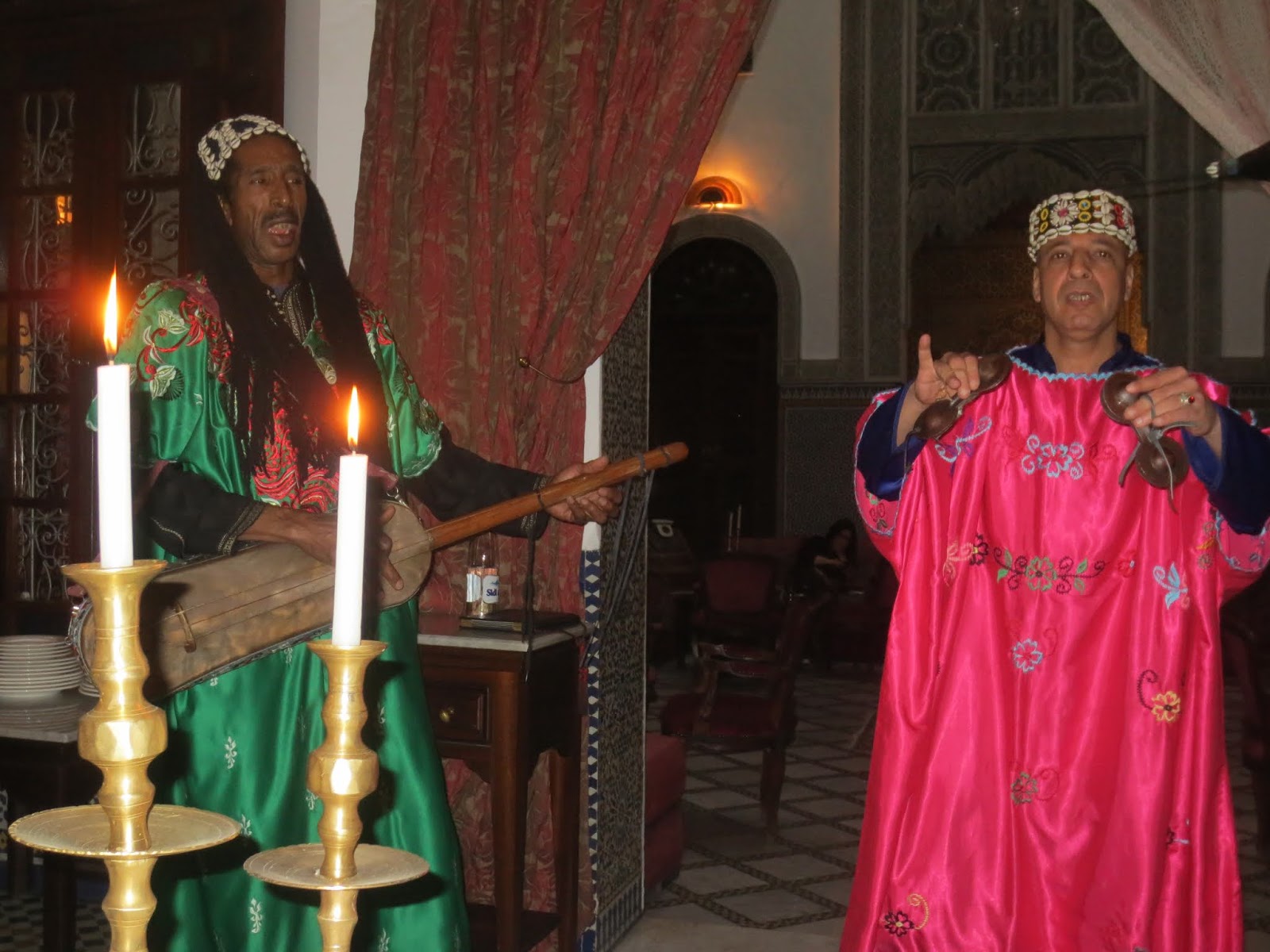
Dinner entertainment in Fez, Morocco
     The following day we headed into the Middle Atlas Mountains. We passed orchards of cherries, nectarines, and peaches, as well as olive groves. After a couple of hours ascending two-lane winding roads with no guard rail, we encountered fog. Our driver “Bob” was not concerned and kept on till we reached the first village, where hundreds of day workers waited in the square to be picked up by orchard owners to work on the Plain of Saiss below. “We’d better turn around,” “Bob” declared, as we made a U-turn in a white-out while the temperature plummeted. In the back seat I wrapped my long wool pashmina over my shoulders and around my neck. 
     “Good idea!” Charley commented. “I was afraid to look down past the side of the car.”  We crept along the white center line down the mountain to the city.
     We drove from Fez south along the coast to Casablanca the next day, passing wide promenades above beaches filled with umbrellas or water parks. Our hotel in that city was on a street barely wide enough for one car, a refuge from the city’s 6,000,000 inhabitants. Shopping malls and condominiums were going up in every direction.
Casablanca skyline
     We made a reservation for dinner at Rick’s Café, made famous in the movie “Casablanca.” Although it was definitely a tourist attraction, the swordfish was excellent ($50 for the two of us, including a drink); we befriended a couple from Australia who owned a B&B on Bali; and we had our photo taken at the piano made famous when Bogart said, “Play it again, Sam.”
Piano in Rick's Cafe, made famous in movie "Casablanca"


  The next morning we visited the Hassan II Mosque in Casablanca, one of the few that non-Muslims can enter. With its mammoth interior and hanging balconies (for the women), it can hold 25,000. Another 55,000 can worship in the surrounding plazas overlooking the sea. The ceiling is nearly 200 feet high, although the roof is retractable so that the interior can be turned into a courtyard. Funded through public subscription, designed by a French architect, and built by a team of 35,000 between 1987 and 1993, it is the third-largest mosque in the world.

The many buildings of Hassan II Mosque, Casablanca, 3rd largest in world
Inside mosques, shoes must be removed. Bags are provided for tourists.

Main entrance, Hassan II Mosque, Casablanca
Main entrance, Hassan II Mosque


Balconies for women inside Hassan II Mosque. Women are not permitted to worship with the men.
     Five times a day faithful Muslims hear their call to prayer (the Muezzin) played on a CD. An estimated 99% of Moroccans are Muslim, with the king able to trace his lineage to the Prophet Mohammed. The second most practiced religion is Christianity; Jewish Moroccans remain another minority. Moroccans on the whole tend to be tolerant of other religions, interpreting Islamic laws in a less conservative way than in many Muslim countries. Modesty in women’s dress, for example, emphasizes covering the skin rather than disguising the female form. Young women around the universities wore contemporary clothing that was form-fitting but covered their limbs.
     It was a Friday, Holy Day for Muslims. After we'd visited the Hassan II Mosque, Rasheed (our guide) deposited Charley and me in a café for lunch, where we ordered sweet and savory bastillas, flaky dough with a filling of either chicken or pigeon. Rasheed excused himself to pray at a nearby mosque and was back in fifteen minutes. “If we have no time to pray, we can do so at home,” he explained. 
     In the mosques, shoes are removed upon entering. Men and women are separated, with a women-only section. On Holy Day, especially, all worshipers must purify themselves before prayer. In the Hassan II Mosque on the basement level there were round sinks of marble for worshipers to wash their hands, wrists, elbows, face, ears, ankles, and feet THREE TIMES before entering the upper sanctuary.
      Hammams were for communal bathing, used by Moroccans once a week before going to the mosque. Charley and I didn’t experience the hammam, since we had our own facilities where we were staying. Small, enclosed, dimly-lit to encourage piety and reflection, whether public or private, hammams segregated the sexes and “Salaams” eased anxiety for a tourist in semi-nudity.

Marble cleansing sinks, Hassan II Mosque, Casablanca


     During a trip to Morocco, my friend Pat followed her tour guide to the waiting bus. There were four men and seven women who had signed up for the “hammam experience” in Tangier, after two days in the desert. One of the men was Pat’s husband.
     The hammam is a bathhouse. Since the Moroccans visit the hammam just once a week, there were probably more foul-smelling Moroccans than Western travelers.
     The group drove to the Ouifak Hammam where two gorgeous ladies, Yatto (age 30) and Etoh (age 26), greeted the seven women. The men in the group expressed their disappointment that they had been greeted by a Moroccan male.
     The seven women followed Yatto and Etoh into a changing room, where a large number of women stood in nothing but their panties. Young daughters stood next to their mothers in the same state of undress. Their djellabas and hijabs (robes and headscarves) hung from pegs.
     Any female who’s tried on clothing in a communal Western dressing room can picture the scene—perky boobs still pointing at the ceiling that hadn’t nursed, saggy boobs in a race to reach the navel, and minuscule boobs that raised the question, “Male or female?”
Tile wall in cleansing area of Hassan II Mosque
      Like the others, Pat and her fellow travelers stripped to their panties. Etoh led them through two rooms of white marble to a wall, where she instructed them to sit on a colorful tile floor covered with hot water. She put a blob of dark olive oil soap in each visitor’s palm and asked them to lather themselves, except for their faces.
     SURPRISE! As in the ice bucket challenge, Pat felt the shock of a bucket of Antarctic water flung at her. The only difference was there were no ice cubes.
     Pat was first in the lineup. She heard Etoh say something and point at her. Etoh wanted her to lie on the hot, wet tiles on her back. Pat followed the gestures to the floor.
     Immediately, she felt a loofah mitt scratching her arm. It seemed like steel wool rubbing her skin off. When that arm was done, the attendant scrubbed Pat’s other arm and then her legs, ending with her stomach and chest. The attendant turned her over like a flopping fish and the torture began on her back and legs.
      “Back to the wall, please.” Pat heard and obeyed, waiting till everyone had a turn with the loofah.     
     SURPRISE AGAIN! Buckets of hot water flew through the air to wash Pat’s dead skin and soap down the drain.
     “Please stand up,” Etoh said. She led the seven Western women in a column to a cooler room, where they sat against another wall to . . . SING! The only English song Etoh knew was “Cum-bye-ah, my lord,” so that’s what they sang. Seven naked ladies sitting against a wall singing “Cum-bye-ah.”
     One by one Etoh brought Pat and her now best-buddies forward for the olive oil rub.  Up one side and down the other, but this time Pat’s beet-red skin stayed in place.
     Shampoos followed. On the wet tile floor, her back to the attendant, Pat aimed her nose to the ceiling and felt water dripping down her scalp, like a neophyte in baptism. The attendant worked olive oil shampoo into the wet strands and combed without restraint. Then more buckets of water.
     But wait . . . Pat’s feet were still unclean! A pumice stone fixed that, removing calluses that had built up hiking in the desert, as well as some live skin.
     Ninety minutes later, Pat and her best-best-friends emerged looking radiant. She didn’t tell me how much the “hammam experience” cost, but she said her husband looked like a new man, so it must have been worth it.


     From Casablanca Charley and I drove to Marrakesh and unloaded our luggage at the exquisite Villa des Orangers, an old French villa with a pool, library, game room, garden, small shop, and outdoor terraces for dining. Our room was similar to that in Riad Myra, consisting of a large bedroom with sofa and television and a tiled bathroom with walk-in shower and tub. The young woman who showed us to our room instructed us to put a fez (hat) on the outside of our door if we didn’t want to be disturbed!
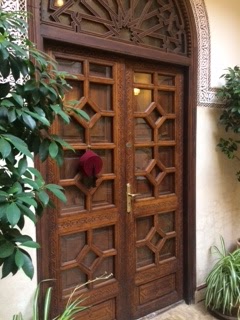
     At poolside that evening we watched two wood storks nesting on electric poles behind the hotel.

Ceiling detail, Villa des Orangers, Marrakesh

Courtyard, Villa des Orangers, Marrakesh
     We avoided any drink that contained ice cubes and only drank liquid from bottles. We declined fresh-washed lettuce but ate the ripe, juicy tomatoes and cucumbers without a problem. Our “salads” were individual dishes of sautéed eggplant or cauliflower, stewed tomatoes, fava beans, or corn. For dinner I enjoyed chicken with figs and lemon and Charley devoured his beef with apricots and plums. Both meals had been slow-cooked in tangines with lids resembling circus tents.
     Since we were unaccustomed to the tipping mores, Rasheed stepped forward to tip whenever necessary: the toilet attendant, subjects of photos, etc. When we purchased souvenirs and arranged for delivery to our hotel, he called the shops to confirm delivery. He paid our entrance fees that had not been prearranged through his agency and bought us cold drinks from vending machines. For all this, we gave him $250 after our eight-day trip ended. After studying our guide book, we were able to use the local dirhams to tip.
Outside the Medina, Marrakesh
     The architecture of Marrakesh resembled the flat, adobe-style, red clay buildings of the American southwest. We relaxed in the Yves St. Laurent Museum (fashion, accessories, and culture of the Berbers) and among the bamboo and palms of Jardin Majorelle, owned by the late designer who had lived next door. However, I was most anxious to take a dromedary ride, offered outside the city in a Berber village. Charley declined, since he’d been on a camel in Egypt that had spit at him.

     Badis, a thirty-five-year-old father of two in bright blue robes, matching headpiece, with two overlapping front teeth, pushed me onto my high square seat atop “Madonna.”
     He assured me “Madonna” was a gentle soul. My thighs spread wide and my feet flopped without stirrups. I bumped up and down for about ten minutes, but soon was able to sit back with the gentle swaying rather than bounce in my seat. I became oblivious to the burning in my thighs. After twenty minutes, Badis handed me the reins. The poor dromedary merely followed his master, who walked beside her. The reins were really for photo ops, as this photo illustrates in silhouette.
     We plodded for an hour through acres of dirt and scrub palms toward his Berber village, wrapped behind high sand-colored walls that blended into the acreage. The only sign of life in the village was a baby crying. Rising beyond was a Club Med property and unfinished villas protruding under mechanical cranes. Water bottles, paper bags, and remnants of meals lay strewn across our trail of dirt, with water (sewage?) gurgling up in a pool far behind Badis’ Berber village.
     Motorcycles zoomed over a far hillside as we rounded the final turn of my ride. “That is my boss,” Badis said, pointing to one of the motorcyclists. Badis took almost fifty photos of me on “Madonna” using my cell phone, reminding me that he was a family man. At the end of the ride, I dismounted to join Charley and Rasheed in a café owned by Badis' boss. Badis followed, to collect his payment and his tip. The tents of the café were shredding, there was no food available (only drinks), the children’s carousel had been abandoned, and rest room faucets yielded no water. At least the toilets flushed! “The Berbers could make something of this for tourists, but they don’t care,” Rasheed said.
     We noticed in Casablanca and Rabat that buses and trolleys traversed those cities. Rasheed told us buses serviced the countryside, and a train ran from Tangiers south to Marrakesh. Below Marrakesh,  a bus ran into the desert. As we whizzed back to Casablanca on an eight-lane toll road, square sand-colored villages blended into the landscape, dwarfed by the backdrop of the High Atlas Mountains. 
     Rasheed and "Bob" walked us to our security screening area in the Casablanca airport.  Rasheed  transferred my carry-on bag to me, which he'd been pulling. He handed me his business card and hugged both of us. "Next time, call me direct," he said. "No fees for the agency!"


Read about our return to the island of Ischia, Italy, in my next blog.


Tuesday, February 26, 2019

A Trip to Mt. Dora, Fl., Part II

     My sister and I spend our winters in Florida and meet half-way for an annual get-together. This year we chose Mt. Dora and I made the arrangements.
     The blue-and-white exterior of the inn was reminiscent of Key West style, but faced Lake Dora. When we arrived, the massive wooden front door was locked. We slammed the brass knocker against the oak panels several times and heard the bolt draw back. Maggie, the proprietor, threw a "Welcome" to us sideways, past the gray wisp that hung near her mouth. "You must be the two sisters we're expecting. Come in." In slippers she led us past the winding wooden staircase (covered in oil paintings of Florida), down the central hall (covered in oil paintings of Florida) to a white wicker folding screen. "We can't let the dogs out," she said, folding back the first section of screen with long fingers that didn't match her diminutive stature. She stepped aside for us.
     "May we leave our bags inside, since we're early for registration? They're in our cars. We'd like to have lunch in town."
     "Of course," Maggie said, swishing aside one of the three cats sitting on the kitchen counter and reaching for registration forms behind canisters of cooking ladles, spatulas, whisks, and tongs. The cat leaped onto the kitchen table. "I'll lock them in the closet down the hall till you return. First I need your information and a credit card for the balance. You paid fifty percent on-line."
     "May I use a rest room, please? We've both had a long ride."
     "Yes, it's right down the hall on the right."
     "Do the cats roam the inn?" my sister asked, concerned about her asthma.
     "No," I heard Maggie respond as I made my way past the table strewn with ceramic salt and pepper shakers representing Santa Clauses, kissing children, and assorted animals, and ducked under hanging pots which could not have threatened Maggie's head.
     Inside the bathroom a cat licked milk from a bowl on the floor. Its white fur was so thin and the ribs so pronounced that I thought we were probably witnessing its last day. I hadn't heard Maggie following me in her slippers, but she  bent down to pick up the cat before I could turn around. "Piddly's sick," she declared. "She got like this once before, but recovered."
     "What is it? Mange?"
     "No, not mange. We're not sure." Then she left me alone.
     When I came out of the bathroom, I trailed a Borzoi back to the kitchen, where it sprawled on a comforter in the sun. There were two other Borzois lying across the floor amid planters of ferns, small palms, and philodendron.
Front porch of our inn with Borzoi statue
Side yard of inn with Borzoi statue
     Borzois, or Russian wolfhounds, are believed to be the mix between ancient bear hounds from Central Asia and tall sheepdogs. Their sleek stature, like the greyhound's, possesses incredible speed, which allowed Russian nobility to hunt wolves and hares. The association with the royal family, however, proved fatal for the breed, as many dogs were disposed of by their owners after the Russian Revolution in 1917. The specimens that remained in kennels, as well as those left with foreigners, were used to rebuild the breed. Everywhere we turned in the inn there were statues or paintings of Borzois. Fortunately, the living specimens remained in the kitchen.
Parlor with Borzois and Xmas decorations, including top of wall!
   
More Borzois over fireplace!
 "Here are the keys to your rooms. I'll put your suitcases in before you return," Maggie said, leading us back to the front hall. "Deidre is still touching them up. If you need transportation, here's a number to call for a shuttle." She handed us a business card from one of the twenty-odd card holders on a desk. The card holders were surrounded by pamphlets in graduated dividers built into the desk. They promoted adventures and eating establishments in the area.
     "I recommend Pices Rising for a fish dinner or the Olive Branch, which is a Mediterranean version of Italian. You'll probably need reservations, with 500,000 visitors coming for the art show this weekend. Any of the restaurants are good. The walking path to town begins at the end of the parking lot. You probably won't be able to get a parking space downtown after 5:00."
     "Would you be so kind as to call Pices Rising for a reservation at 7:00 for us, please?"
     Maggie secured our reservation. In town, lunch was as good as her claim. Afterward, we ventured into shops featuring nostalgic coats, dresses, shoes, crafty beach decorations, artists' galleries, and antiques. We saved the museums for the following day.
     Back at the inn, we entered our rooms to unpack. We were surrounded by lace doilies, four-poster beds with flowery faded chintz, and faux Tiffany lamps. On the bureaus laminated sheets announced a cold breakfast would be served until 9:00, after which there would be eggs and sausage ("Please reserve for the hot breakfast!"). In my bathroom sugar ants scurried out from under the faucet when I turned the water on. A wooden shelf unit hung over the toilet but the shelves weren't wide enough to hold my makeup case. The only thing in my room that was new was the television mounted on the wall and the mattress. There were at least eight oil paintings of the local Florida area. I had a beautiful view of Lake Dora, as did six of the other rooms. My sister had no view, next to the garage, but she had her own patio and didn't have to climb the one or two flights of stairs. I fell asleep in my clothes.
     When we met downstairs for dinner, we explored the parlor and dining room. Collections of china plates and glassware covered in dust stood in china cabinets in both rooms. Antique cash registers provided the backdrop for a carousel horse. Santa waved an arm with a mini bulb in his candle or towered over bowls of Christmas balls, although it was February. A briny scent emanated from a glass container of star fish amid ceramic Christmas trees and plates stacked for breakfast. A chipmunk held a barrel of mini golf clubs for an unidentifiable purpose.
     Maggie must have been a frequent shopper at the Antique Emporium in town, which was two-football-fields long. Statues, paintings, or prints of Borzois reigned over everything. More chintz flowers covered the round tables in the dining room.
   
    "Do you think we should eat here in the morning, with the cats and dogs in the kitchen?" Cindi asked.
     "I'm only gonna eat a wrapped muffin or some cereal from a box."
     We got a ride to town for our dinner reservation. Again, an outstanding meal!
     Afterward, we needed a ride back to the inn. We called the number on the business card for the shuttle, but it had shut down at 8:00. No answer when we called two taxis. "Is there Uber or Lyft we could call?" I asked the maitre d'.
     "Not here," he said.
     "Well, we can't walk back to the inn in the dark. What do you suggest?"
     "We're going to be closing in about fifteen minutes. If you can wait, I'll give you ladies a ride."
     Fifteen minutes later Devin pulled his dune buggy around to the front of the restaurant and I climbed in the back seat. Except there was no seat, so I sat on the floor. Cindi sat next to Devin. "This reminds me of our trip to St. Maarten," I said to my sister, laughing. "Remember when Quinn pulled out too fast and the back seat of the jeep collapsed? Mom and Dad ended up on the floor!" After that remark, Devin slowed down around the turns. We were grateful for his ride and tried to thank him with a generous tip, which he refused.
     At breakfast I passed up some crusty banana bread for a wrapped muffin while Christmas music blared through the speakers and Maggie explained to anyone who'd listen how she'd acquired her Borzois.

To be continued: A Collection of Florida Highwaymen's Paintings.....


Monday, August 27, 2018

Travelogue, Spanish Basque Country, 2018

     After leaving France for the coast of Spain on the Basque Corniche, we checked into the Maria Cristina Hotel in San Sebastian. Built in 1912, the facade resembled a Belle Epoque palace. We were led to a sumptuous room, recently renovated in grays from slate to fog. In fact, the entire hotel had been renovated in 50 shades, from "greige" (beige with a touch of gray) to thundercloud. A plaque on the door next to us proclaimed it had been Bette Davis' suite while she was in residence. She had actually stayed there just three days before her death. Her photos remained on the walls of the bar and grill room off the lobby.
Hotel Maria Cristina, San Sesbastian, Spain
     San Sebastian is known for three things: its spectacular beaches, its Parto Vieja ("Old Part" of the city), and its food. The international jazz festival in July and international film festival in September call San Sebastian home. We walked around Monte Urgull, the hill that rises abruptly at the edge of the Old City along the peninsula's shore and used toothpicks to spear pinxtos ("haute cuisine in miniature") with olives, green or red peppers, anchovies, pork meatballs, or fried potatoes, displayed on a bar. The bartender tallied them up, along with the Rioja district wines we'd sampled, when we were ready to leave.
     The following day we shopped inside the old walled city and walked the broad promenade above Playa de la Concha, the beach closest to the city with waves less formidable than the eastern Playa de Zurriola, which attracted international surfers. On the far western end of the Gulf of Vizcaya was Playa de Ondarreta, with few amenities. For dinner (10:00 p.m. in the Parto Vieja) we wound down narrow alleys to sit against a newer version of the old city walls in a restaurant where fishermen unloaded their catch in the front and the cooks hustled the catch inside. We ordered some greens and a lobster salad to share. When the "salad" arrived, a mountain of seafood sat on a platter before us: two cooked, split lobsters; steamed mussels and clams; potatoes; tomatoes; whole onions; kernels of corn. At home in Massachusetts we called this meal a "clam boil" or a "lobster bake," depending on whether it's boiled in a steamer pot or cooked over seaweed in a pit. Somehow we managed to devour our "salad."


Views of city of  San Sebastian from amusement park atop Mt. Ulia with Pyrenees in background. Surfers' beach is around promontory to left.


    Basque poet Kirmen Uribe summed up the appeal of his native coastline between San Sebastian and Bilbao: "I'm going to stay here - between the green waves and the blue mountains." We drove west along the coast through Zarautz, a former whale-hunting town with extensive photo museum and huge surfing waves rivaled only in Mundaka, which boasted long rollers and left-curling pipeline. "Hip" sculptures lined the beach promenade in Zarautz. We followed the twisting sea road west through Zumaia, a fortified medieval town with fossils embedded in rock cliffs where artist Ignacio Zuloaga thought the light magical. Next were Ondarrao and Lekeito, the Basque Country's leading fishing ports with major tuna fleets. Finally we headed inland toward Gernika and  Bilbao.
     Picasso made the Basque village Gernika (Basque spelling) famous with his mural representing Spain in the 1937 International Exposition of Arts and Techniques in Modern Life (Paris). In April, 1937, German Luftwaffe planes terror-bombed the Basque town of Gernika at the invitation of General Francisco Franco. Why Gernika? Since medieval times, regional leaders of the Basques had gathered there beneath an ancient oak tree to govern themselves. The fierce independence of the Basques, alone in opposing Franco's bid to overthrow the elected government, offended him. His German allies killed between 200 and 2,000 citizens in the village on a market day but missed the oak.The black and white photos in newspapers reporting the bombing infuriated Picasso, so he painted the mural in stippled grays, evoking those first reports and the dark cloud of war. His mysterious images brought the cause of Spanish suffering before the world. Picasso vowed his mural would never be exhibited in Spain as long as Franco lived. It was returned to Spain from exhibition in N.Y.C.'s Museum of Modern Art following repatriation in 1981.
    

     As recently as the 1980's Bilbao was a steel and ship-building city in decline. Bilbainos thought the government crazy to court a major museum and name an architect to create another landmark (Frank Gehry). But civic audacity paid off. The Guggenheim Bilbao, an "armored beast" in metal, opened in 1997 and jump-started a transformation of the riverfront. A city of 355,000 has now become a laboratory for contemporary architecture. Cesar Pilli created a master plan of walkways, contemporary sculpture, and innovative architecture for the city. 
     The Casco Viejo or "Old Town" is a compact triangle nestled on a bend in the river. Basque identity is the subject of the Museo Vasco, while the Archeological Museum traces the human presence in the region from the arrival of Neanderthal man to the emergence of a coherent Basque region in the Middle Ages. The Museo de Bellas Artes is a gem of a conventional art museum outside Casco Viejo on the Guggenheim side of the River Bilbao..


Entrance to Guggenheim Museum, Bilbao, Spain
Jeff Koons'  3-story flower "Puppy" outside 


View of Guggenheim Museum from street


Three-story fabric "creature" hanging in atrium


     A three-story sculpture of flowers titled "Puppy" by Jeff Koons stands on the esplanade outside the Guggenheim. Three mimes' arms extend from tented blankets to perform to music along the walkway. A two-story iron taranchala titled "Maman" by Louise Bourgeois stands behind the building. 
     Walking through the building necessitates an audio tour, as the museum experience is cutting edge. One is walking through a grand sculpture, certainly with more star quality than many of the exhibits, in my opinion. The artwork is sometimes ten feet to three stories high, floating suspended or sunk in concrete, mind-boggling in conception, weight, and installation. The Chagall exhibit is the only one hanging on the walls. Signage is in Basque, Spanish, and English.
     An exhibit titled "Art and China after 1989: Theater of the World" caused me to flee. I followed Charley into the first room, dominated by two gigantic boxes on platforms. The structures were surrounded by lucite walls that rose above our heads. The contents of the two boxes looked like children's dioramas. Statues of Buddhas sat along a green hillside. Below the hillsides were openings resembling grottos. Lifelike tortoises and a yellow snake with brown markings sat motionless on the hillside beside a pool in the first eight-by-ten-foot box. I turned to the attendant standing along the wall. "Those aren't real, are they?" I said.
     "Oh yes," she answered.
     Just then the tortoise moved one leg. Then the other. Which caused the snake to raise its head and move forward an inch. I moved quickly to the next box, approximately twelve-foot square.
     When I got there, SIX snakes emerged from the opening under the diorama. The yellows, corals, greens, and browns muddled together in a tangle, as the snakes crawled over each other. I ran. 


Tuesday, July 17, 2018

Cuban Travelogue, Part V

   
South coast looking toward Cienfuegos and Caribbean

Machete cutter of sugarcane climbing with ropes and hob-nailed shoes 

   
View toward Fla. Strait from former coffee plantation in the Sierra del Rosario Mts., northwest Cuba. Each seedling was planted.
     After four days eating the national cuisine of pulled or roasted pork, fricasseed or grilled chihcken, black beans and rice, some of us experimented with local specialties like ceviche or octopus. Mojitos, Cuba Libres (the national cola mixed with rum), and Pina Coladas were served liberally with ice cubes from the local water supply. As a result, several of our group began to have gastrointestinal ailments. There was a doctor on duty 24/7 in our hotel, who provided an antibiotic shot in the derriere. "Octopus is notorious for causing your problem," he told the patients. There was no charge.

    Excluding hotels, public restrooms throughout our tour had attendants standing outside with a roll of toilet paper. With the equivalent of a $.25 tip, one received several sheets before entering. There were none inside. A bucket stood next to each toilet to prevent paper from being flushed into the sewer system.
Havana skyline I

Havana skyline II
     At the end of our week-long sojourn we had the highly-anticipated ride through Havana in classic cars of the 50's. There were approximately 60,000 vintage cars throughout Cuba. Owners needed permits from the state to maintain their status, if they wanted to use the cars as vehicles for tourism. "Everyone must survive," our Cuban guide told us, "even the inspectors." Translation: the inspectors accepted bribes. "Car owners find spare parts on the internet. The engines are patched together with parts from Europe and the Soviet Union. Some owners have three old motors in reserve."

Artist Jose Fuster's casa outside Havana,  made entirely of ceramics

St. Francis Cathedral, Havana, across from the cruise ship terminal
     Our vintage car did not disappoint! Charley and I rode in a 1950 Buick with its original engine. Only one windshield wiper worked and the speedometer had died a long time ago. When it started to rain, the owner put the canvas top up. Each of us got wet through a two-inch gap, but we didn't even feel it!

A 1950 Buick for our ride through Havana


A fellow traveler took our photo in the rear view mirror
Batista's office in his Havana palace. During the Revolution he escaped through a side door and fled the country.


Cathedral o f Havana at night


Department of Tourism employees, Havana
Another Tourism Dept. employee
Park Havana

Ted doing a selfie
Ronnie and Amit in the back seat  
                                                                                                                                                                                    The End