About Me

My photo
Delray Beach, FL, Westport, MA, United States
Undergraduate degree, Colby College; MA in English, Columbia Teacher's College; former high school English teacher in three states; former owner of interior design co. with MA from R.I. School of Design. Barking Cat Books published my first book in 2009 titled, MINOR LEAGUE MOM: A MOTHER'S JOURNEY THROUGH THE RED SOX FARM TEAMS. My humorous manuscript titled ELDERLY PARENTS WITH ALL THEIR MARBLES: A SURVIVAL GUIDE FOR THE KIDS was published in June, 2014. In 2015 A SURVIVAL GUIDE won a gold medal in the self-help category at the Florida Authors & Publishers Association conference. In 2018 Barking Cat Books published my SURVIVING YOUR DREAM VACATION: 75 RULES TO KEEP YOUR COMPANION TALKING TO YOU ON THE ROAD. See website By CLICKING HERE.

Tuesday, July 17, 2018

Cuban Travelogue, Part V

   
South coast looking toward Cienfuegos and Caribbean

Machete cutter of sugarcane climbing with ropes and hob-nailed shoes 

   
View toward Fla. Strait from former coffee plantation in the Sierra del Rosario Mts., northwest Cuba. Each seedling was planted.
     After four days eating the national cuisine of pulled or roasted pork, fricasseed or grilled chihcken, black beans and rice, some of us experimented with local specialties like ceviche or octopus. Mojitos, Cuba Libres (the national cola mixed with rum), and Pina Coladas were served liberally with ice cubes from the local water supply. As a result, several of our group began to have gastrointestinal ailments. There was a doctor on duty 24/7 in our hotel, who provided an antibiotic shot in the derriere. "Octopus is notorious for causing your problem," he told the patients. There was no charge.

    Excluding hotels, public restrooms throughout our tour had attendants standing outside with a roll of toilet paper. With the equivalent of a $.25 tip, one received several sheets before entering. There were none inside. A bucket stood next to each toilet to prevent paper from being flushed into the sewer system.
Havana skyline I

Havana skyline II
     At the end of our week-long sojourn we had the highly-anticipated ride through Havana in classic cars of the 50's. There were approximately 60,000 vintage cars throughout Cuba. Owners needed permits from the state to maintain their status, if they wanted to use the cars as vehicles for tourism. "Everyone must survive," our Cuban guide told us, "even the inspectors." Translation: the inspectors accepted bribes. "Car owners find spare parts on the internet. The engines are patched together with parts from Europe and the Soviet Union. Some owners have three old motors in reserve."

Artist Jose Fuster's casa outside Havana,  made entirely of ceramics

St. Francis Cathedral, Havana, across from the cruise ship terminal
     Our vintage car did not disappoint! Charley and I rode in a 1950 Buick with its original engine. Only one windshield wiper worked and the speedometer had died a long time ago. When it started to rain, the owner put the canvas top up. Each of us got wet through a two-inch gap, but we didn't even feel it!

A 1950 Buick for our ride through Havana


A fellow traveler took our photo in the rear view mirror
Batista's office in his Havana palace. During the Revolution he escaped through a side door and fled the country.


Cathedral o f Havana at night


Department of Tourism employees, Havana
Another Tourism Dept. employee
Park Havana

Ted doing a selfie
Ronnie and Amit in the back seat  
                                                                                                                                                                                    The End      


Thursday, July 5, 2018

Cuban Travelogue, Part IV

     One of our most interesting tours was the H. Upmann cigar factory in Havana. Inside a cement building five stories high, iron railings surrounded an open atrium. There was no air-conditioning. A huge photo of Fidel holding what must have been an Upmann cigar hung down the inside of the building in front of us. "Sorry, no photos above ground level," the factory guide warned us. "No stealing secrets."
Fidel and his cigar watch over the factory.
     The tobacco leaves had been cut in the fields and dried on racks in barns, where they were spritzed with a combination of water and a flavor (rum, e.g.). Because of the humidity in Cuba, the environment served as a natural humidor. Originally, field hands read Romeo and Juliet or The Count of Monte Cristo to those cutting in the fields. The cigars took their names from the books being read. Today, I wouldn't be surprised if cigars were named Fifty Shades of Gray (or 64 Shades, because there are 64 cigars in a box).
     We began by walking up cement steps to the fourth floor, where women and a couple of men sat behind glass in rows of high-top tables, removing veins from the dried leaves and sorting them by color and shade. There were three colors and eight shades of each color. One woman had her daughter sitting next to her doing homework. Both waved at us.
     We walked down the stairs to another level. On this floor, employees rolled, pressed, and cut the leaves into shape, securing the end with a rubbery natural liquid from Canada that acted as glue. Each worker had a different quota per day, depending on the shape and size of the cigar. A worker rolling and pressing Monte Cristos, for example, had a quota of 90 cigars/day. We watched through the glass as workers at long tables, both men and women, smoked cigarettes, drank beer, or watched movies on their cell phones between finished products. The jobs were highly paid and handed down through the generations, provided the applicant passed entrance qualifications. A ten-month training period was mandatory for everyone in the factory. On another level down, a paper ring slid onto the shaft of each product, which was then boxed in an adjoining room.
One of the products of H. Upmann Cigar Factory in Havana
     Back at our hotel, Geo. Lopez-Sanchez, Professor of Economics and International Relations, discussed the Cuban economy. When the U.S. OK'ed flights into the country, the total number of tourists rose from 500,000 to 1,000,000 in one week. Canada sends the highest number, with the U.S. in second place, though declining. "What infrastructure can be fixed if goods and remittances coming into our country are hidden and can't be taxed? What should the visitors' revenues be used for first?" he asked.

     The Executive Director of the Fundacion Ludwig de Cuba gave us a tour of the National Museum in Havana. "There is one work that depicts our country's recent journey," he told us, leading us to the collage titled, "Revolucion" by Alejandro Aquilera. "The word 'Motherland' is a colloquialism for us, referring to a political movement that is unfinished and constantly changing. Our allegiance after the Revolution is not to individual rights but to independence as a whole. In this collage, the artist started on the left with strong letters, which deteriorate toward the end into fragments. It is a mix of many materials and scenes, just as Cuba is a mix of peoples and beliefs. The bloody revolutionary fervor no longer sustains us, but the concept is unfinished. We are mingled in grayness."
"Revolucion" by Alejandro Aquilera, National Museum, Havana
     Confirming that point of view, our Cuban tour guide told us, "In general, Cuban people today have no specific religious beliefs. We pick and choose a little from this and a little from that. If we were born after the Revolution of 1959, we have no idea what Christmas represents. Christmas trees are only placed in tourist hotels. Our backgrounds are Spanish, African, English, Chinese. The tribes native to the island were almost completely exterminated when they were used as laborers by the Spanish."
Art from the Revolution, National Museum, Havana


        On a free night, Charley and I walked to Sloppy Joe's restaurant near our hotel. It was an offshoot of the bar made famous by Hemingway in Key West. Hemingway had befriended the owner there and persuaded him to open a second establishment in Havana, where Hemingway had a residence.
Hemingway's boat dry-docked on the tennis court at his Havana estate
     We both ordered cheeseburgers. They arrived an inch-and-a-half thick. "Could we have some ketchup, please?" Charley said.
     "I'll look," the waiter said in English.


     He came back several minutes later. "Sorry, but this is the only one I could find. We don't expect another shipment this week." He handed Charley a bottle of congealed red paste, stuck in the neck of the bottle.
     "Cuba is like a 40-watt light bulb," one of our group members quipped.


                       To be continued...

Tuesday, June 12, 2018

Cuban Travelogue, Part III

     On our "People-to-People" tour of Cuba we visited a maternity home serving the province surrounding Cienfuegos on the south coast. Maternity homes provide residential care for expectant mothers from rural areas or with high risk pregnancies. There are no charges, of course. A doctor and nurse are on duty 24/7. In Cuban pediatric ICU's, there is a 97% survival rate. Eight percent of births are Cesarean, provided only if a doctor orders them. No epidurals are given. As the expectant mothers told us in the maternity home, "Cuban women are strong."
     In general, Cuban men frown on vasectomies and although prevention of births through education is the state's focus, family planning is a "nightmare," as described by our Cuban guide. With the over-sixty population around twenty percent, the state encourages babies, of course. However, young people can't rise economically (in 2017 the average Cuban salary was the equivalent of $27/month) and postpone having families. There are no more free layettes from the state and with child-support laws requiring only the equivalent of $2/month per child, divorce is high. Condoms are listed on menus at every cafe and bar. As one of our tour group quipped, "Coffee and condoms - five cents, please."
Symbol for a B&B in Trinidad, with laundry drying on the roof


`
View from our hotel in Cienfuegos on south coast

Lobby of Hotel Sevilla, Havana
      We wound our way to Havana on the northern coast and checked into Hotel Sevilla near the National Theater and Sloppy Joe's. In the terracotta courtyard combos performed day and night. Throughout the country there is music - in cafes on the street, on the sugar cane plantation we visited, in bars and nightclubs, in the ears of young people in Havana listening to play lists. The people find a way to make the best of their circumstances. We were taught Salsa moves one night on the waterfront (no photos available!).


National Theater, Havana


Even the statues play music in Havana
Star performers singing of their country and Mother's Day at their elementary school
Entertaining ourselves with music on a sugarcane train
Carmen and a local at a cafe during a rainstorm.
       
       Upon our arrival at the hotel we were served our first Mojitos, offered at every subsequent stop. There was only a whiff of something rum-flavored in our drinks. Our room was spacious with scaffolding outside our window, though no workers ever appeared. The floor tiles and toilet had large cracks (luckily we didn't fall through!); one of two elevators was cordoned off; and during torrential rains in the late afternoon two parties in our group had to mop their floor, due to leaky windows. One of us, "J," requested an envelope at the front desk. "No, no envelopes and no stationery," she heard. Instead the receptionist reached for a sheet of paper, folded it into approximate thirds, and stapled the ends. "Your envelope," she said, handing "J" her request. Two new hotels were being built near the waterfront, joint ventures between Spanish and French companies and the Cuban government.
   
     We attended a lecture by retired architect/ professor Miguel Coyula. He opened his remarks by saying, "Havana is crumbling!"
Typical apartment building, Havana

A study in contrasts.
     One-fifth of the Cuban population lives in Havana (2.8 million), while three buildings A DAY crumble to rubble in the city. A toilet costs 333% of a month's wages; a gallon of paint costs 20% of a month's wages. Residents can "own" an apartment by leasing it from the government for 20 years. They cannot sell it and have no control over anything happening outside their own four walls (there is no building administrator or board of directors). With six to ten people living in three-room apartments, conditions aren't maintained. "When the U.S. embargo is lifted, will the Cuban government be ready for the tsunami of foreign investment?" the architect asked rhetorically.
     Two billion dollars flowed into Cuba through remittances from relatives in the States during the '90's, but the funds were used for "passive personal consumption" or put into hidden accounts, thereby avoiding taxes. "A disparity is growing between the population who has no foreign source of goods/funds and those who do or who leave for foreign jobs for 1-2 years, bringing their savings back with them," said the architect.
     That evening we stopped at a bar in Old Havana named "The Small Grocery in the Middle of the Street" (La Bodeguita del Medito). A huge crowd hung out on the cobblestones, talking and drinking while a combo played inside. The city was perfectly safe at night (no guns, no crime). Hemingway frequented this bar while he lived in Havana with wife #4. We pressed against the crowd inside the open storefront to see what Hemingway had written on a piece of cardboard over the bar: "My Mojitos come from La Bodeguita. My daiquiris come from La Floridita" (another bar).
     A blond American tourist spotted Tucker, one of our group who sported a white beard and white hair combed back behind his ears. "Hemingway!" she yelled above the salsa music, pointing at Tucker.
     "Just call me Papa," he quipped.
     "Hell, no! Never happen!" she yelled, turning her back in hasty retreat to the curb. We called Tucker "Papa" for the rest of the trip.                                                           To be continued...


Our "Papa" Hemingway

Monday, June 4, 2018

Cuban Travelogue, Part II

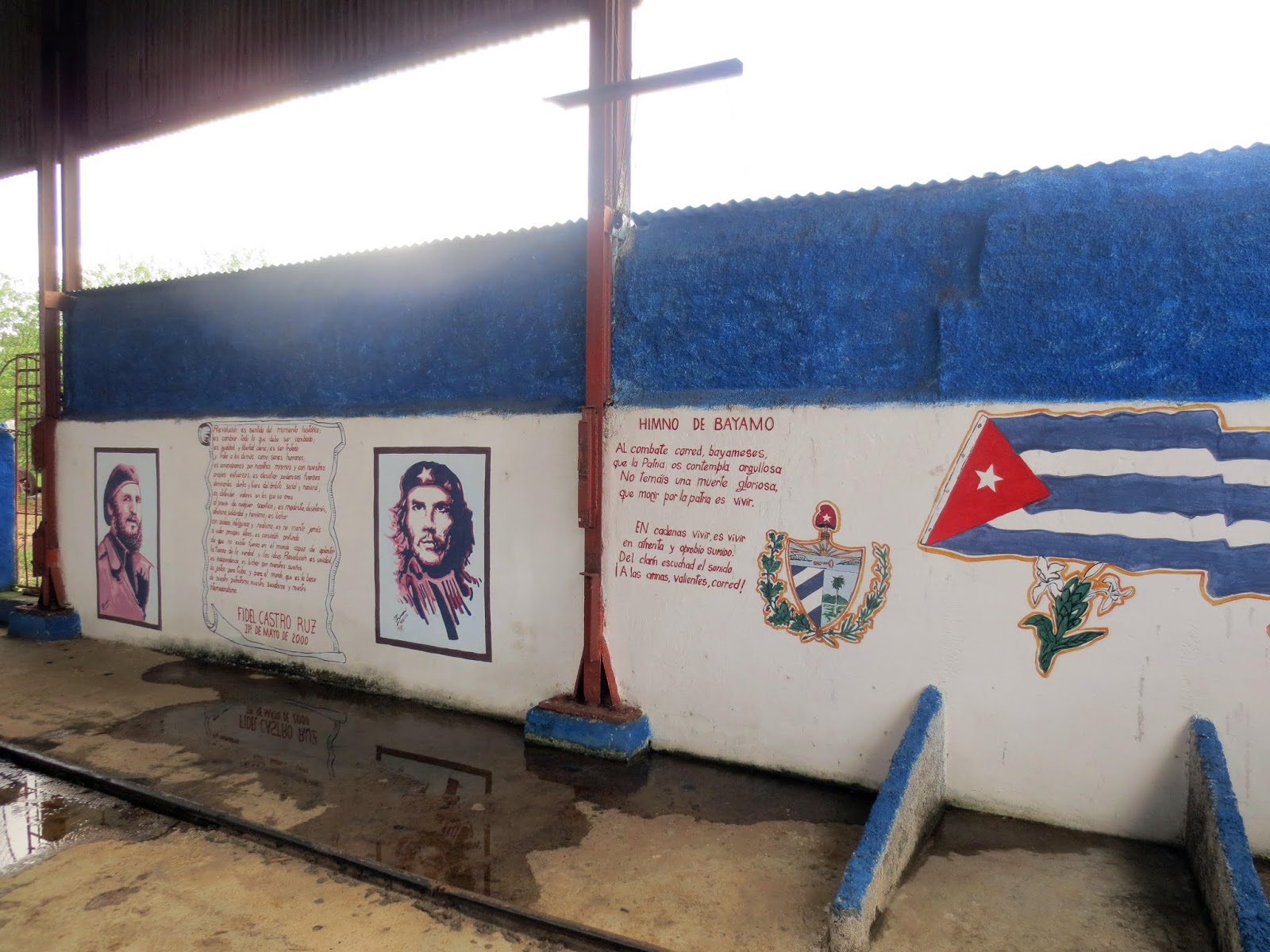
     During a bus ride, our Cuban tour guide (whose name I will omit) explained the government allows a farmer to own 165 acres maximum, and small Cuban farmers are the wealthiest in Cuba today. If they own 165 acres and lease another 165 from the state, they can sell their own crop privately and sell the crop on government land back to the state (at a reduced price). Although Raoul Castro relaxed regulations regarding small entrepreneurs owning their own businesses (for a percentage of the profits - restaurants, barber shops, bakeries, e.g.), billboards did not advertise products or services. They advertised instead the Castros, Che Guevara, the motto "Unity Is Strength" (with the Cuban flag), or a denunciation of the U.S. embargo. Even the facades of buildings were political. Raoul retained his position as head of the Army and Communist Party when Diaz-Canel became President in 2017. Only 2-3% of the population are presently Communist Party members.
Facade of government building, Havana                                   
"The bustling and victorious revolution goes forward":
Billboard at sugar cane plantation

     "The embargo is hurting the people," our guide told us. "It will not hurt those in power, but it hurts all of us who have to get a prescription written for the smallest medication or drug, like aspirin. We must buy our prescriptions at state pharmacies, subsidized by the government." Often there is no supply.

    Our guide and his wife and two children built onto his parents' house to live. There is a ten-year wait for government-approved housing, often made with shoddy construction methods because of a lack of materials or theft of materials. The wait is lengthy because the disabled, active and retired military, or politicians rise to the top of the list.

     "All citizens must carry national ID cards," he told us. "It's not a driver's license, but a laminated card we get after age 16. Before that age, we must carry a booklet. There is a fine if we are caught without a card.

     "I have tried twice to get a Visa for the States. Each time I waited a year for the interview, and each time I was denied. We are allowed on our first visit to bring back 300 pounds of goods. People bring back TV's, tires, baby carriages, clothes and sell them to their neighbors on the installment plan. We also have our own version of Craig's List."

     Our bus whizzed past hitch-hiking stations on the road, jammed elbow-to-elbow with a government-paid Co-ordinator supervising lines and pickups. Professionals like doctors and nurses, as well as day laborers, hopped aboard horse carts or former U.S. and Soviet Union military trucks (now private buses), or squeezed six or more into compact cars. The "buses," leased from the government, had open slats on the sides, a canvas cover over a metal roof, and metal seats. Outside the cities, the crowded buses carried chickens, pigs, kids. Unsanitary conditions were common and fistfights often broke out among those trying to get to work on time. A liter of gas cost two days' pay and in general was unavailable except to government tour companies, those in the tourist business, and the military. Cars were repaired with a patchwork of used imported parts. Trains were unreliable and constantly broke down.
Motorized taxi bikes, Cienfuegos

     Free health care is universal in Cuba. Twenty-seven percent of the national budget goes to health care. There is one doctor per 130 families. When a doctor graduates from medical school (education at all levels is also free in Cuba), she has a 2-year commitment wherever the government sends her. Males have a 3-year commitment, including one year in the military. Doctors receive free housing and an office if assigned to a rural area. If a doctor receives permission to work outside the country, he must commit to return.

    Health centers provide multiple services, including dentistry, ultrasound, X-rays, operations on a 24-hour basis. Specialists rotate from hospitals one day a week to the health centers. The facilities may not have the latest technology or equipment, but the doctors' training is excellent. There are 151 hospitals on the island, with a 4.2% infant mortality rate per 1,000 born. There is no drug crisis in Cuba (and no gun sales). Crime is almost nonexistent.

     The average age expectancy in Cuba today is 78.45 years.We visited an elderly home run privately by nuns, although state-run elderly homes are free. Seventy percent of the patients in the facility tithed their entire pensions every month. Meat was served only on Sunday, provided by donations from the outside. White beans were provided by Spain. Red beans, grown in Cuba, were served at every meal. All medical and psychological needs were taken care of, including dental and hospitalizations. The patients had private apartments, with furniture provided.

Snapshot in courtyard at private elderly home
Courtyard at private elderly home
Ceramic tiles in hallway of private elderly home


Physical therapy equipment in private elderly home


     Inez, a witty 76-year-old resident of the Catholic retirement home, was our tour guide. She told us her story. At age 19 after the Revolution, she was told by Communist party members to give up her Catholic beliefs or leave the university. "It would be like cutting out my heart," she told the officials. Her studies were left behind. She accepted our thanks, our best wishes, and our tips.
Inez, our guide through her Catholic elderly home in Havana.


To be continued...

Wednesday, May 30, 2018

Cuban Travelogue, Part I

Thirteen of us headed to Cuba for eight days with our Adventure Holidays International guide Amit, a U.S. resident and Tel-Aviv native, former Israeli Defense Forces officer, and tour operations/management director. The thirteen of us had responded to a brochure from Brown University describing the trip. Among us were Ted Widmer, Brown U. professor and author of Brown: The History of an Idea, as well as a former banking colleague of Charley's and her husband (a delightful coincidence!). Ten of us were New Englanders; three were from New York. The Red Sox-Yankee rivalry rekindled each morning, following a report of the previous night's game.

Our group at the U. Havana, minus our guide Amit 
The tour would meet U.S. requirements for "people-to-people" travel to Cuba, based on our scheduled events. Traveling with tour operators who have the necessary Treasury Department license makes visiting the island legal for citizens of the U.S. Cruises also dock at Cuba's ports, with limited time and/or access to mainland tours. From the southeastern coast through central Cuba to Havana and west, our days would be filled with museums, lectures, concerts, dance recitals, tours of elderly and maternity homes, educational facilities, artists' studios, a sugar cane plantation, a former coffee plantation, a cigar factory, Hemingway's home, an ecologically sustainable community, and, of course, the mandatory ride in classic cars of the '50's. We would eat in family-run paladars, state-owned restaurants, and at barbecues where pigs stretched on spits.

Amit informed us we would be flying into Santa Clara rather than Cienfuegos, because the latter had not been rebuilt after Hurricane Irma ravaged it in 2017 as a category 5 storm.

Upon arrival we were interviewed and photographed individually. A doctor and a nurse collected our health forms. Our Visa forms had been stamped in Miami and would be collected when we departed Havana. We met our Cuban guide, whose name I will not include. He traveled with us the entire week. In perfect English, he explained that due to regulations, Professor Ted and Amit would not be allowed to give us lectures. "I was a teacher of English as a foreign language," he told us, "before I became a tour guide. I earned the equivalent of $23/month in Cuban pesos as a teacher. Now I earn the equivalent of $20/month. We have to become creative." We assumed the change in professions was due to the tips he now kept. Our guide supported his wife and two children, as well as his mother and father. We appreciated his honesty and during the week asked any questions that popped into our heads. "I will try to answer you honestly," he said, "but I may not have an answer or you may not like the answer."
View from our window toward Bay of Cienfuegos on Cuba's south coast 
   
Cuba is almost 800 miles long, the largest island in the Caribbean. We drove two hours south to the coast and checked into the Hotel Jagua on the Bahia (Bay) of Cienfuegos. Our room cost around $150/night in the high season. By U.S. standards it would have been a three-star hotel. The door to our room had no bolt (however, there is never a safety issue, even at night on the streets - no guns are sold on the island and crime is nonexistent); public toilets in the lobby had backed up without a sign; SIMS cards for Wi-Fi were not available, "but maybe tomorrow."

Mansion confiscated by Fidel's revolution on the grounds of our hotel.
 
The following day we drove east along the coast to the town of Trinidad, a UNESCO World Heritage site. Foothills of mountains rose to our left and the Caribbean teased to our right. It was the land where Fidel had gathered his revolutionaries, hiding in caves. His portrait was universal, along with Che's. Despite reports of stark-white, deserted beaches, we didn't have time to savor them.
Art gallery, Trinidad
Local transportation, Trinidad

 Ration cards in a government redemption grocery
Local transportation and hat seller, Trinidad


We visited a government redemption grocery in Trinidad. Its shelves were almost bare, with the exception of a hefty supply of rum. "Our ration cards must be used in national redemption groceries, which have supplies and prices determined by the state," our guide said. "After age seven, no child receives milk on his ration card. The cards do not provide food for the entire month, maybe ten or twelve days." On a blackboard were the standardized amounts a half-pound of black beans or one cup of sugar cost in rations per person for the month. Twenty-five government pesos (used by Cubans) equaled approximately $1 or 1 Cuban convertible peso ("Cuc," used by tourists). Our dollars added a 10% tax to any item we purchased. Euros were more convenient, without any tax attached.

While in the redemption grocery, I tried to get a photo. I bent down to lean on the counter, where a scale rested for purchases. The counter was black with flies, feasting on the gritty sugar.

    
Flea market, Trinidad
Main square, Trinidad
Street scene, Trinidad
The birdman of Trinidad (with dozens of filled cages), selling hats from his three-room house.
Statue mimes, Trinidad

To be continued...


Tuesday, May 1, 2018

The Amazing Adventure of Florida Sea Turtles


Feeling better! Turtle Rehab Center, Juno Beach, Fl.
     We live on a stretch of beach in southern Palm Beach County, Florida, that witnesses a miracle of nature every year. On three miles beneath our windows, thousands of female sea turtles return at night to lay their eggs between March 1st and October 31st. In 2017, there were 1077 nests, the highest number ever recorded in our area. It is estimated nearly ninety percent of all sea turtle nesting in the U.S. occurs right here (www.sunny.org/beaches/sea-turtles).

     We have four species that return to our area: loggerhead, leatherback, green, and hawksbill. Since artificial lighting discourages the females from nesting on the beach, there is an ordinance in Florida (and fine for offenses) that all outside lights must be turned off or inward during nesting season.

     The females' tracks are as big as a tractor's tire marks. They dig holes in the sand, lay around one hundred golf-ball size eggs, cover the hole with sand, and spread sand over a large area to disguise the hole. Then they reenter the water. Although I have seen the track marks in the sand, I have never witnessed the nocturnal nesting.

     Incubation will last 45-55 days. The hatchlings will use reflections from the moon to find their way to the water at night. Only one out of a thousand will survive the predators and the tides.
Sick turtle getting an IV at Juno Beach Rehab Center, Fl.
     A New York Times article by Karen Weintraub (April 17, 2018, pg. D2) reports findings that sea turtles use the earth's magnetic fields to navigate back to within 40-50 miles of where they were born. Each beach has a distinctive magnetic signature, which the turtles find through something called "geomagnetic imprinting." In a study of loggerheads at the U. North Carolina, Dr. Kenneth Lohmann and J. Roger Brothers determined there was "more genetic similarity among turtles that nest on beaches with similar magnetic signatures than among turtles that nest on beaches physically close to each other."
Wheelchair for sick turtles, Juno Beach Turtle Rehab Center, Fl.

     In our area of beach, a non-profit called Sea Turtle Adventures provides daily monitoring of the nests on a three-mile stretch. They stake the nests, relocate them as needed, and excavate them after hatching. The group also provides documentation and reporting of predation events, offensive artificial lighting in the evening during nesting season, and obstructed nesting attempts. It co-ordinates efforts to document and transport dead or injured sea turtles to a rehabilitation facility (such as the Juno Beach Center), and provides annual reports to the Florida Fish and Wildlife Conservation Commission.