About Me

My photo
Delray Beach, FL, Westport, MA, United States
Undergraduate degree, Colby College; MA in English, Columbia Teacher's College; former high school English teacher in three states; former owner of interior design co. with MA from R.I. School of Design. Barking Cat Books published my first book in 2009 titled, MINOR LEAGUE MOM: A MOTHER'S JOURNEY THROUGH THE RED SOX FARM TEAMS. My humorous manuscript titled ELDERLY PARENTS WITH ALL THEIR MARBLES: A SURVIVAL GUIDE FOR THE KIDS was published in June, 2014. In 2015 A SURVIVAL GUIDE won a gold medal in the self-help category at the Florida Authors & Publishers Association conference. In 2018 Barking Cat Books published my SURVIVING YOUR DREAM VACATION: 75 RULES TO KEEP YOUR COMPANION TALKING TO YOU ON THE ROAD. See website By CLICKING HERE.

Monday, November 14, 2016

Snapshots from Italy VI - Women's Feet

Women's feet take a beating in Italy.  When people pass you on the street there, the first thing they look at is not your eyes or even your watch or your jewelry.  It's your shoes.
Fendi Runway Mules $925.

Prada Silver Stiletto Sandals $700.
Prada Gladiator Sandal $950.
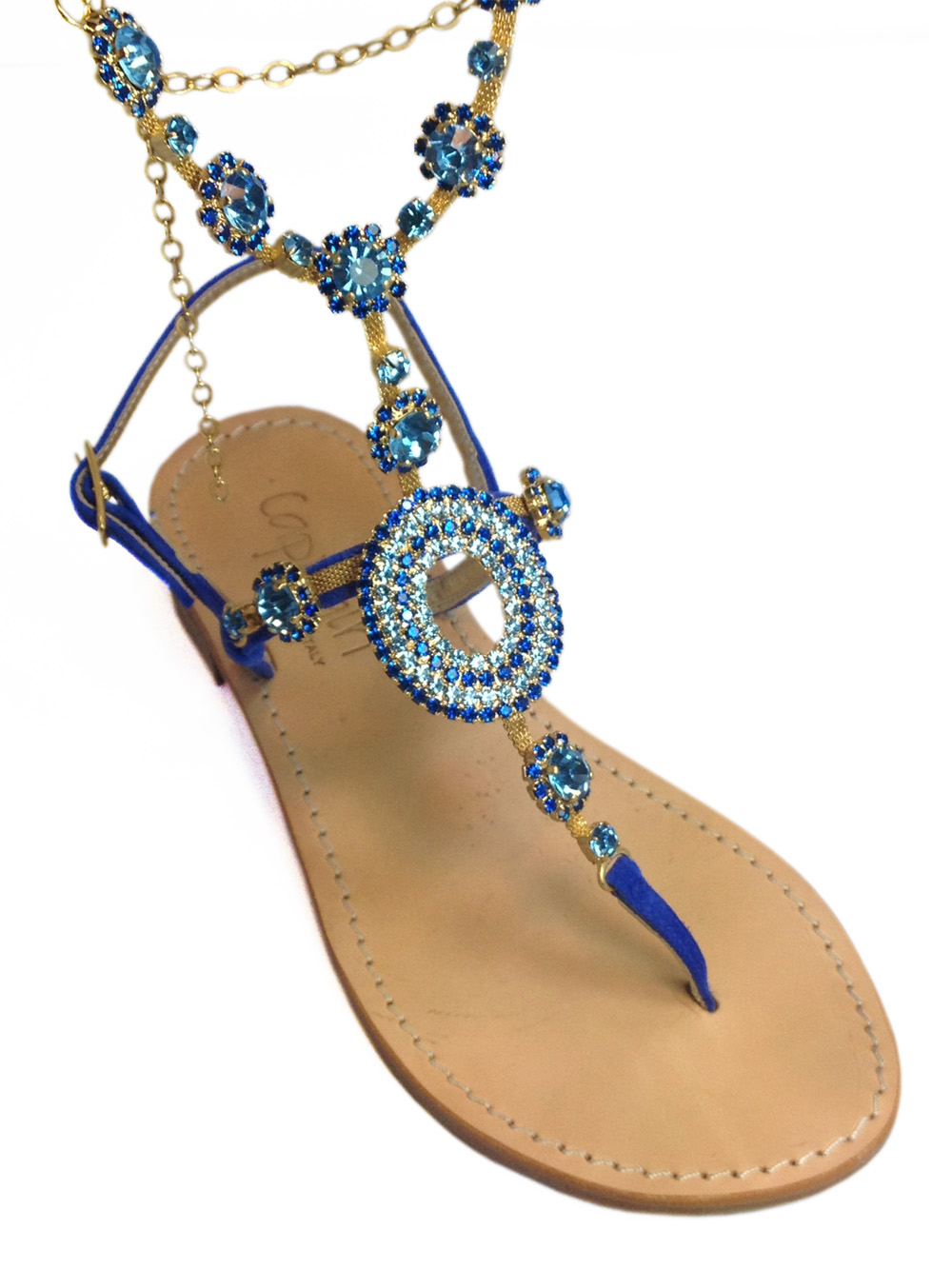
Capri-Girl Embellished Sandal $250.
Italians are famous as shoemakers throughout the generations and the leather is soft as butter.  Especially in cities they dress smartly and never look sloppy. Even jeans can make a statement with a lace top on the ladies (sometimes sheer) or a fitted jacket. Only women tourists wear shorts in Italy.  Milan, the fashion capital of the country, is the home to the design houses of Armani, Bottega Veneta, Canali, Dolce & Gabbana, Etro, Les Copains, Marni, Missoni, Miu Miu, Moschino, MSGM, Prada, Tod's, Valentino, Versace, and E. Zegna, among others.
Dolce e Gabbana poppy print dress $1315.

Of course, not many people there wear designer shoes or clothes.  Nevertheless, there is pride in the way a scarf is tied around a neck or in a chunky necklace or in a pocketbook, no matter how tiny,  that matches the shoes.  As a guest in their country, I try to dress with respect for their customs and a nod to affordable fashion. I don't pack sweatsuits.

However, I cannot acquiesce to the Italian women's custom of wearing stilettos or any kind of heels throughout the day. All I can walk in these days are sneakers with cushiony inserts, having spent my teen years in pointed Cappezio flats, with resulting bunions.  When I taught high school classes I stood in three-inch heels for years. I wore heels up and down the inclined cobblestones of Hong Kong as a guest of Charley's bank, while our host tried not to smirk. Four months before visiting Italy this year I tore the Plantar Fascia ligament on the bottom of my foot, necessitating a soft boot for six weeks, followed by six weeks of therapy.
In preparation for our departure I packed two pairs of extremely comfortable walking shoes (sneakers), a pair of flat shoes for dinner, and one pair of sandals for the pool. All of them had orthopedic inserts.

In southern Italy, where the weather is warm, sandals predominate...the higher the better.

Capri is famous for its jeweled designs, but flip-flops are everywhere...even on women who ride their bikes home after a weekly trip to the grocer's.

Eighty-year-old women walk up and down steep, often crumbling steps in sandals, carrying their satchels. Steps are a way of life, leading from village to village.
Steps to the sea at our hotel on Ischia
Up to our room, Mezzatorre Hotel, Ischia

However, women in five-inch heels also parade their baby strollers over cobblestone streets.  Fashion is always on display.

Men in southern Italy, like American tourists, wear sneakers!  Charley was no exception (see photo above).


Saturday, October 29, 2016

Snapshots from Italy V - The Inevitable Weight Gain

Some breakfast pastries, Mezzatorre Hotel, Ischia, Italy
Despite our walking every morning and brief work-outs in hotel fitness centers, our stomachs always looked like a Buddha's after several weeks of travel, especially in Italy. We had no will power when Caprese cake with chocolate and almond bits or apple tart with homemade jams every color of the rainbow sat slivered on platters for breakfast.
More breakfast pastries
After staying seventeen years at the same hotel on the island of Ischia, our breakfast chef (Sylvestro) delivered his SURPRISE specialties to us, split onto two plates, usually after we had finished a Continental breakfast with yogurt, fruit, and a slice of cake or some granola with a croissant. We received, for example, omelettes with creamy ricotta filling or over-easy eggs on thick homemade toast, topped with fried mozzarella.  We loved the pride he took in his work but resorted to sneaking in and out of the breakfast room before he could spot us. It was just too much food - troppo!
Breakfast chef Sylvestro at the Mezzatorre Hotel,  Ischia, Italy

Pastas are all made daily in any establishment that serves food in Italy, no matter whether it's a five-star ristorante or the tiniest neighborhood trattoria.
Local food products and liqueurs on Ischia
My will power completely disappeared when flat spaghetti with vongole and cozze (clams and mussels) in a butter Parmesan sauce was on the menu and Charley caved in the minute he saw rigatoni in minced veal ragout or lasagna.  It helped our waistlines that Ischia was in the southern region of Italy, since Southern Italian food is lighter (local catch of the day from the sea) than Northern Italian (ragu sauces and Bolognese, consisting of local meats). Nonetheless, pasta was always a course on the menu prior to the entree. We tried to skip at least one course and dessert. Of course, we sampled local wines or Prosecco (my favorite) with every meal and Limoncello afterward.
Author friend Margie Miklas in a cooking class in Puglia.  Used with permission.
Sparkling Prosecco wine
Limoncello - an after-dinner favorite 
It would take all summer to lose the added pounds, but it was all part of the experience.  If we went into withdrawal symptoms after returning home to diets, we could always eat at Camille's or The Old Canteen "on the Hill" (Federal) in Providence, R.I., where the Sicilian mob had dined before retiring to jail.
Pineapple symbol of hospitality at entrance to Federal Hill, Providence, R.I., and signage for Old Canteen Restaurant

Friday, October 21, 2016

Snapshots from Italy IV - A Neighborly Dispute

The half-mile driveway to our hotel on the island of Ischia was under construction for eighteen months. The hotel owner was in a dispute with his neighbor (who shares the driveway) as to who should pay to fix the road.  Meanwhile, guests could either walk up the hairpin turns high over the Tyrrhenian Sea or wait at a staging area for the hotel to retrieve them on golf carts.

We first noticed in 2012 that stones from the wall along the driveway had tumbled down the hillside.
Walkers could become ghosts, swallowed by gaping voids that delineated the sides of the roadway. "This is a prestigious hotel and I don't understand why the owners can't negotiate a settlement," I said to Charley. "They're a member of a chain that must demand inspections."

"You'd think they'd have paid off the neighbor," Charley, the pragmatist, said.

"There has been a dispute as to who owns the part that needs fixing," the hotel manager told us with eyes on his shoes.  "They won't accept our offer."

In 2013 a new rock wall appeared where the driveway had been disintegrating.  The neighbor had constructed a ninety-degree angle where the property divided.  The walls created such a narrow turn that large taxis scraped their sides trying to get through. Unless we were in Lilliputian cars, we had to wait for shuttles to bring us up to the hotel. It was imperative we chose a small taxi to manage the turn if we decided not to walk.


I could hear the neighbor saying to our hotel owner, "Gotcha!"

Wednesday, September 28, 2016

Snapshots from Italy III - Hiring a Taxi in Ischia

Haggling with the taxi drivers in Ischia was "Fun at first," Charley told me.  On alternate mornings we walked the winding half-mile descent to the town of Lacco Ameno below our hotel, then along the coastline another mile-and-a-half to Casamicciola, the town beyond.  On our return we stopped for a light lunch in the marina facing Vesuvius, across the Tyrrhenian Sea.
Mt. Vesuvius across a marina on Ischia
All the shops were closed between 1-4 p.m. on the island, likewise with the hotel shuttle from town.  With a torn Plantar Fascia ligament (mine) and joints complaining from old football injuries (Charley's), we sometimes grabbed a taxi back to our hotel before heading to the pool or the sea.

Lunch stop in Lacco Ameno, Ischia

During the lunch hours in Lacco Ameno, the cab drivers sat along a wall, like birds on an electrical wire. The first time we approached them we made the mistake of asking the driver sitting in the last cab (closest to us) to take us back. No other drivers were sitting in their cabs.
Sunday after church, Lacco Ameno, Ischia

The driver whose cab was first in line hurried off the wall and began shouting at the driver we'd approached, sweeping his arms in large window-washing motions, while their noses got closer and closer and their voices louder and louder. The driver we'd approached ushered us into his van, hurling insults while flinging his free hand toward his pursuer. Thankfully, we've never seen anyone resort to punches in Italy.

Flea market on Sunday, Casamicciola, Ischia

"Un momento!" I said.  "Quanto costa?"

"Quindici Euros."

"Fifteen?  It's only a mile and half up the road!" Charley said.

"Prezzo minimo, signore," he said.

Our driver started his engine and we roared past the curses of the first driver, our necks lurching forward and Charley's leg dangling from the open door.

The next time we approached the lineup, none of the drivers got off the wall.  In fact, they wouldn't even look at us.

"Mezzatorre Hotel?  Quanto costa?" Charley said.

"Venti (20)" was the response.

"No, not twenty!  Fifteen," Charley said.

"Non, venti."

"You enjoy yourselves, have a good rest!  We'll walk," Charley announced.

And we did!

Halfway up the steep, circuitous hotel driveway a renegade driver stopped next to us. "Dieci (ten)," he said.

We jumped in.


Monday, September 12, 2016

Snapshots from Italy II - Our Morning Walks


Our hotel on the Italian island of Ischia sits on a promontory overlooking the Tyrrhenian Sea between the towns of Lacco Ameno and Forio.  We spend each morning walking miles up and down the hillsides to work off the pasta (not always a successful remedy!).  One of our favorite walks winds through the forest above our hotel, past the Italian film director's house (which sits at the end of a dirt road), past a bocce court as the road becomes asphalt, along the coast to an overview of Forio. Then we wind down cobblestone streets past the Church of San Francesco de Paola, past the beach resorts in Forio and the marina, to a cafe in town for a cold drink.

View from our hotel promontory


Tower rooms in our hotel and pool

At the beginning of this walk to Forio we must descend our hotel's half-mile driveway. Part-way down there is a sign that reads, "Madonna di Zaro" (Madonna of the Hillside).

Charley and I ascend the dirt path through the forested hillside toward the shrine, which sits atop winding wooden steps.  On this walk, we are not alone. In a dirt car-park, taxis and a van wait in leafy shade for their customers, who begin to file singly down the steps after their supplications. Scattered next to the vehicles are picnickers' plastic bottles, sandwich wrappers, melon rinds, and the condom evidence of lovers' trysts.

Having been blessed by the Madonna, the group assembles to board the van.  "You sit in back (in Italian)," one woman directs.
                                                                              "No, I sit next to my husband in the middle," the other woman answers.

"Take a different seat!" she hears.  "Angelo and I want middle."

Angelo and his wife get their wish.  If only the Madonna had the power to cleanse the wooded hillside as she had (dubiously?) cleansed the petitioners' souls!

*********************************************************************************

Overlooking the town of Forio, Ischia
Down a serpentine, one-way street on our way to Forio, we wait to enter the blind curves till we hear no engines. We slow at families' niched shrines and again at the Church of San Frencesco de Paola (half-way down the twist of S-turns) before entering the narrow tunnel just past the church's pink facade.  In the middle of the tunnel we hear a car approaching from behind, but there is no place to disappear. The tunnel is just wide enough for one car.  The horn blares at Charley, behind me on the cobblestones.  "You honking at me?" he yells.  "Slow down and wait!"
A family shrine

Of course, the woman doesn't understand a word!  She waits till we exit the tunnel before shouting curses as she passes.

On the roads hugging hillsides on Ischia, sidewalks are built as a brief nod to the tourist, then they disappear. Crosswalks are mere suggestions. Charley decides that since crosswalks are meaningless, he can cross where he pleases.  He grabs my hand and holds his free hand up like a traffic cop, defying two lanes of traffic to stop or hit us.
Forio, Ischia

Once we get past the beaches, we hug the sides of cobblestone houses and produce shops while cement trucks and faces frozen behind glass in tour buses whiz at forty-five mph within twelve inches of our sucked-in stomachs. Young girls with their arms around their boyfriends' waists zoom around us on cycles, the boyfriends yelling back to them and flinging one hand in the air with fingers together like blown kisses for emphasis. Taxi drivers never disrupt their phone conversations around blind curves. We stand on the asphalt's six-inch shoulder, waiting till Charley can swing out into the curve with me following. He uses a sideways pushing motion away from us, certain that motorists coming out of the curve will see him and make NASCAR moves to avoid us. Ahead of him, housewives in flip-flops with their groceries defy the drivers without ever looking up.

Forio, Ischia

In front of one market, a car slows to claim its parking space.  It's the same space where Charley is walking. "Hey, stop!" he yells to the female driver, who stops within three feet of his upright palms.


Out jumps Nana, with her cloth grocery bag. "Quoi?  Quoi?" Nana asks.

In other words, "What's your problem?  Don't you know my daughter owned a motorino (motorbike) when she was six?"

.
Fruit and vegetable vendor in Forio
Blind curve on Ischia

Another blind curve on Ischia


Monday, August 29, 2016

Snapshots from Italy I - A Return to Ischia

This is dedicated to the memory of those who perished this week in the terremoto (volcano) of central Italy. May they rest in peace.


For seventeen years we have visited the Italian island of Ischia.
Aragonese Castle   474 B.C.
The island faces Capri and is a 45-minute hydrofoil ride across the sea from Naples. Every year the general manager, Giovanni, at our hotel and the staff at the front desk (Mena, Pino, Salvatore, Britt) welcome us to our favorite room high on the hillside behind the lobby. Our knees get creakier each year as we ascend the endless stone steps and descend to the lobby, dining terrace, pool, and sea.

Down to the pool and sea
Pool and tower rooms

Each evening we dine al fresco (and each morning we walk miles to work off the pasta). From the hotel's dining terrace we watch the splendor of lavender, orange, and pink sunsets fade over fishing boats returning to their ports far below.

Dining terrace with two hungry seagulls
A surprise anniversary cake overlooking sunset
One evening at dinner a couple from Birmingham, England, approached our table.  "I couldn't help but overhear," the woman said, "that you've been here before."

"Yes, it's our seventeenth time on the island," Charley said.  "We love it here!"

"We've been twice before to this hotel and love it because it's only a three-hour plane ride from London to Naples. We're half-way through our ten days. Where are you from?"

"Delray Beach, Florida, and the coast of Massachusetts."

The next day we walked along the main street in the town below the hotel, Lacco Ameno.  We stopped to talk when we saw the Englishman standing outside one of the shops. "Wife's inside, buying out the place," he said.  We could see her bent over a glass case of coral jewelry.

Disguised in dark glasses and a baseball cap, Charley shook the Englishman's hand.  "We're staying at the Mezzatorre, where you're staying," Charley said.

The Englishman looked at him without recognition.  "Oh, you're from the States?"

"Yes, we're from Delray Beach, Florida."

"Funny, I just met another guy from Delray Beach who's staying at our hotel."
Harbor in Lacco Ameno, Ischia
That's the story of Charley's face - everyone thinks he's someone else. One time a guy in an airport stared at him across the terminal while we waited for our flight. Finally he screwed up his courage and approached Charley.  "I think I know you. Didn't I go to high school with you in Omaha, class of '69?"

Charley graduated from high school in Fall River, Massachusetts, and it was definitely not in '69!


Tuesday, August 16, 2016

Amsterdam: Europe's Most Intimate City

We never visited Amsterdam until June, 2016.  The 800-year-old city is dubbed Europe's "most intimate" because it has less square mileage than other major cities and its flat landscape (filled with canals) makes it extremely walkable - if you don't mind taking your life in your hands.


In this city, the bicycle has the right of way.  That's right - NOT pedestrians, who have to look both ways four times, and NOT cars.  Bicycles outnumber cars two-to-one in Amsterdam and residents claim automobiles will never conquer their city. The many hump-backed bridges sporting narrow cobbled streets over picturesque canals are meant for pedestrians or two bikes abreast.  Rush hour brings bike grid-lock, as well as canal grid-lock ("lock-lock"), though trolley lines and bus routes are efficient.


It is a city of many roles - capital, world port, transportation hub, university and world banking center, world trade center (diamonds are still sold on every corner), venue for world-renowned concert halls, and gathering place for the avant-garde in the arts.  It is lively and high-spirited, with a laissez-faire attitude.  The Red Light District is a stop on walking tours. Legal cafes that cater to pot-smokers display a special decal in their windows.  Needles are dispensed to drug addicts at free clinics.

Cafe selling cannabis
The Netherlands has more museums per square mile than any other country in the world, and 92 of them are in Amsterdam.  They range from the fascinating Biblical Museum to the titillating Sex Museum, and from the huge Rijksmuseum to the grippingly preserved Anne Frank House. All but seven of the museums in Amsterdam are privately-owned and nearly all charge an entrance fee.

If you plan to visit at least 4-5 of them, there are options to save money:
- Museum Pass (allows you no entrance fee)
- Combination Canal Cruise and Museum Entrance or hop-on-hop-off bus and/or boat
- Museum Boat - provides up to 50% discount on entrance to museums on its route
- Amsterdam Card - comes with other benefits, such as discounts at
   attractions and restaurants and free use of public transport system

Most museums are closed on Mondays with the exception of the Rijksmuseum (Netherlands' National Museum with over 1,000,000 works of art), the Van Gogh Museum, and the Stedelijk Museum (National Museum of Modern Art).


We took a canal cruise and a half-day walking tour which covered most of the major landmarks in the city. Before our departure from the States we'd purchased tickets to the Rijksmuseum and Van Gogh Museum for specific days.  In both museums we purchased headphones for self-guided audio tours.

The crowds at both museums were enormous at 10:00 a.m. and also at 4:00 p.m. We chose to follow only highlighted items on the self-guided tours but couldn't follow the sequence in the Rijksmuseum.  We wound around bodies, trying to peer at numbers on the paintings to push our audio buttons.  Sometimes we could only get a glimpse, although the larger the painting (e.g., Rembrandt's "The Night Watch"), the easier it was to get up close. Because of the number of people, there was little room for them to step back so that others could step forward.
Hotel de l'Europe, Amsterdam

The experience that we will remember most from the city was our visit to the Anne Frank Museum (also prepaid for a specific date and time).  The house is preserved as the family left it when arrested in 1944, with the exception of display cases featuring Anne's diary.  It is an emotionally gripping journey to climb the stairs behind the hidden bookcase to the rooms eight people inhabited, including the sink where they prepared meals, the toilet that couldn't be flushed because of noise, the radio with news from the BBC, the attic that allowed a view of blue through a skylight (all windows were covered with blackout curtains), and the bedroom where Anne and her sister spent two years tacking posters of movie stars and phrases from books (still on the walls).
Facade and front door to Anne Frank House

We traveled to The Hague, the seat of government and official residence of Queen Beatrix, an hour outside Amsterdam.  It is home to diplomats and international organizations, including the International Court of Justice and prison that held Bin-Laden, with dozens of embassies and official residences.  The Binnenhof complex, facing a little lake, houses Holland's two-chamber parliament and elaborate Knight's Hall, used for state occasions.

The gem of The Hague is around the corner.  The Mauritshuis is small as museums go, situated in a 17th-century palace.  The paintings have been acquired since the 18th century by the princes of the House of Orange.  The works were seized by Napoleon in 1795 and taken to France, returned to the Netherlands in 1816 after Napoleon's defeat at Waterloo.  In 1821 they were transferred to the Mauritshuis and exhibited publicly the following year.  The collection is known for its enchanting Vermeers, its many Rembrandts, and a full panoply of Dutch and Flemish masters.  There were no crowds and we stood directly in front of Vermeer's "Girl with the Pearl Earring,"  his "The View of Delft," and Rembrandt's "Anatomical Lesson of Dr. Nicolaas Tulp," among others, as long as we liked.
Vermeer's "Girl with a Pearl Earring," courtesy of the Vermeer Foundation

One note of caution:  DO NOT let your limbs wander near any of the furniture on display! Charley's sleeve grazed a gilt Louis XIV desk as he jokingly declared what a nice touch that would add in his office.  Bells and alarms sounded as we back-pedaled away.  Two guards appeared at our sides. "His foot," our tour guide explained in Dutch, pointing to the base of the platform under the desk.  "It must have tripped a wire."

"Happens all the time," said one of the guards.
Flower market, Amsterdam