About Me

My photo
Delray Beach, FL, Westport, MA, United States
Undergraduate degree, Colby College; MA in English, Columbia Teacher's College; former high school English teacher in three states; former owner of interior design co. with MA from R.I. School of Design. Barking Cat Books published my first book in 2009 titled, MINOR LEAGUE MOM: A MOTHER'S JOURNEY THROUGH THE RED SOX FARM TEAMS. My humorous manuscript titled ELDERLY PARENTS WITH ALL THEIR MARBLES: A SURVIVAL GUIDE FOR THE KIDS was published in June, 2014. In 2015 A SURVIVAL GUIDE won a gold medal in the self-help category at the Florida Authors & Publishers Association conference. In 2018 Barking Cat Books published my SURVIVING YOUR DREAM VACATION: 75 RULES TO KEEP YOUR COMPANION TALKING TO YOU ON THE ROAD. See website By CLICKING HERE.

Thursday, August 22, 2019

Notes from Morocco, June, 2019, Part III

This is the last in a series of blogs about a recent trip to Morocco. 


     After experiencing the Medina of Fez for four hours, we needed to clean up and chill out. At dinner in the Palais Faraj we enjoyed the company of a friend I'd grown up with and her granddaughter.
Marilyn, Claire, Charley, Pam
Our itineraries intersected at two locations, but their journey would end in the desert (south). Charley and I skipped the desert experience because of the heat in June.
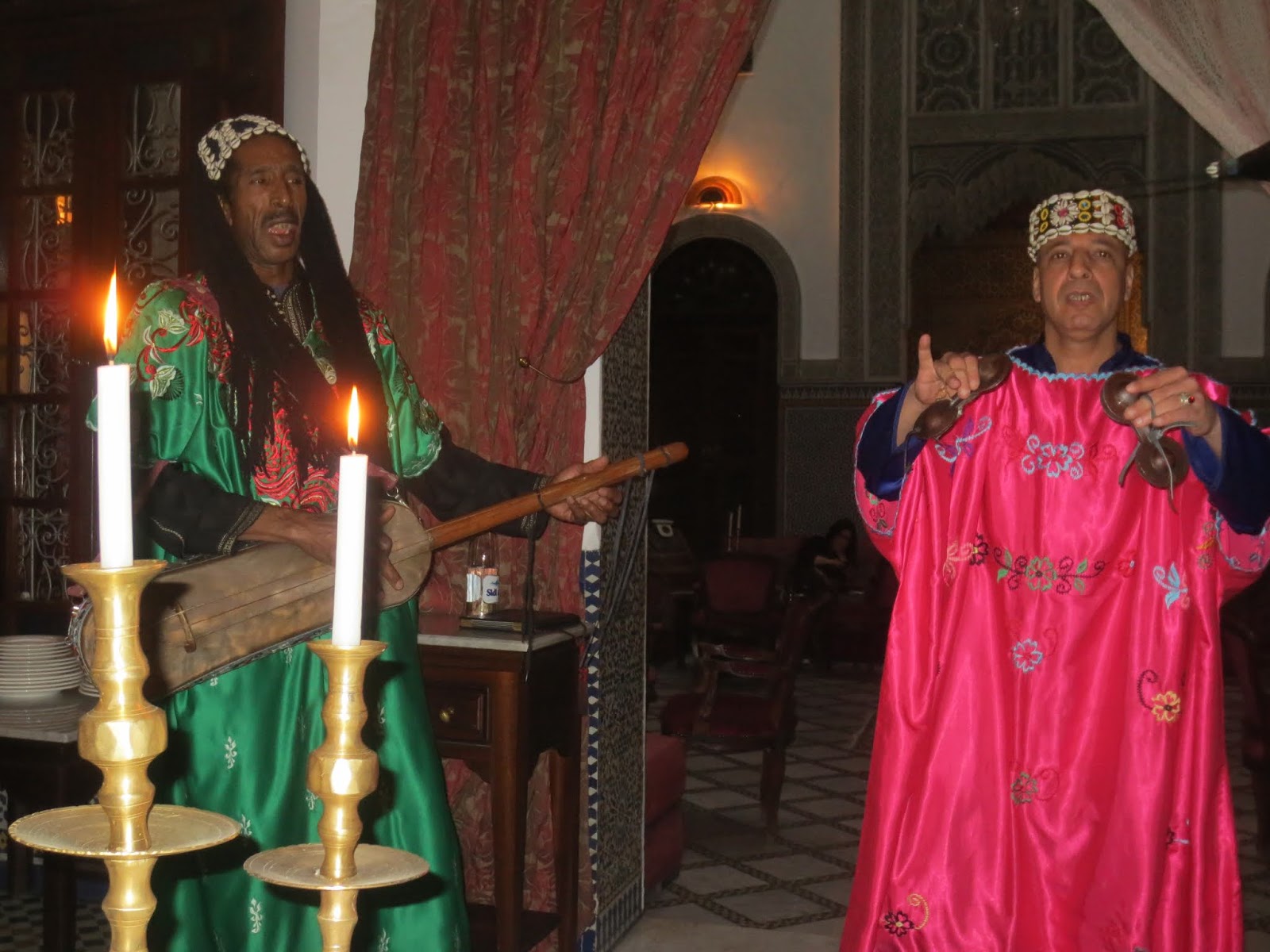
Dinner entertainment in Fez, Morocco
     The following day we headed into the Middle Atlas Mountains. We passed orchards of cherries, nectarines, and peaches, as well as olive groves. After a couple of hours ascending two-lane winding roads with no guard rail, we encountered fog. Our driver “Bob” was not concerned and kept on till we reached the first village, where hundreds of day workers waited in the square to be picked up by orchard owners to work on the Plain of Saiss below. “We’d better turn around,” “Bob” declared, as we made a U-turn in a white-out while the temperature plummeted. In the back seat I wrapped my long wool pashmina over my shoulders and around my neck. 
     “Good idea!” Charley commented. “I was afraid to look down past the side of the car.”  We crept along the white center line down the mountain to the city.
     We drove from Fez south along the coast to Casablanca the next day, passing wide promenades above beaches filled with umbrellas or water parks. Our hotel in that city was on a street barely wide enough for one car, a refuge from the city’s 6,000,000 inhabitants. Shopping malls and condominiums were going up in every direction.
Casablanca skyline
     We made a reservation for dinner at Rick’s Café, made famous in the movie “Casablanca.” Although it was definitely a tourist attraction, the swordfish was excellent ($50 for the two of us, including a drink); we befriended a couple from Australia who owned a B&B on Bali; and we had our photo taken at the piano made famous when Bogart said, “Play it again, Sam.”
Piano in Rick's Cafe, made famous in movie "Casablanca"


  The next morning we visited the Hassan II Mosque in Casablanca, one of the few that non-Muslims can enter. With its mammoth interior and hanging balconies (for the women), it can hold 25,000. Another 55,000 can worship in the surrounding plazas overlooking the sea. The ceiling is nearly 200 feet high, although the roof is retractable so that the interior can be turned into a courtyard. Funded through public subscription, designed by a French architect, and built by a team of 35,000 between 1987 and 1993, it is the third-largest mosque in the world.

The many buildings of Hassan II Mosque, Casablanca, 3rd largest in world
Inside mosques, shoes must be removed. Bags are provided for tourists.

Main entrance, Hassan II Mosque, Casablanca
Main entrance, Hassan II Mosque


Balconies for women inside Hassan II Mosque. Women are not permitted to worship with the men.
     Five times a day faithful Muslims hear their call to prayer (the Muezzin) played on a CD. An estimated 99% of Moroccans are Muslim, with the king able to trace his lineage to the Prophet Mohammed. The second most practiced religion is Christianity; Jewish Moroccans remain another minority. Moroccans on the whole tend to be tolerant of other religions, interpreting Islamic laws in a less conservative way than in many Muslim countries. Modesty in women’s dress, for example, emphasizes covering the skin rather than disguising the female form. Young women around the universities wore contemporary clothing that was form-fitting but covered their limbs.
     It was a Friday, Holy Day for Muslims. After we'd visited the Hassan II Mosque, Rasheed (our guide) deposited Charley and me in a café for lunch, where we ordered sweet and savory bastillas, flaky dough with a filling of either chicken or pigeon. Rasheed excused himself to pray at a nearby mosque and was back in fifteen minutes. “If we have no time to pray, we can do so at home,” he explained. 
     In the mosques, shoes are removed upon entering. Men and women are separated, with a women-only section. On Holy Day, especially, all worshipers must purify themselves before prayer. In the Hassan II Mosque on the basement level there were round sinks of marble for worshipers to wash their hands, wrists, elbows, face, ears, ankles, and feet THREE TIMES before entering the upper sanctuary.
      Hammams were for communal bathing, used by Moroccans once a week before going to the mosque. Charley and I didn’t experience the hammam, since we had our own facilities where we were staying. Small, enclosed, dimly-lit to encourage piety and reflection, whether public or private, hammams segregated the sexes and “Salaams” eased anxiety for a tourist in semi-nudity.

Marble cleansing sinks, Hassan II Mosque, Casablanca


     During a trip to Morocco, my friend Pat followed her tour guide to the waiting bus. There were four men and seven women who had signed up for the “hammam experience” in Tangier, after two days in the desert. One of the men was Pat’s husband.
     The hammam is a bathhouse. Since the Moroccans visit the hammam just once a week, there were probably more foul-smelling Moroccans than Western travelers.
     The group drove to the Ouifak Hammam where two gorgeous ladies, Yatto (age 30) and Etoh (age 26), greeted the seven women. The men in the group expressed their disappointment that they had been greeted by a Moroccan male.
     The seven women followed Yatto and Etoh into a changing room, where a large number of women stood in nothing but their panties. Young daughters stood next to their mothers in the same state of undress. Their djellabas and hijabs (robes and headscarves) hung from pegs.
     Any female who’s tried on clothing in a communal Western dressing room can picture the scene—perky boobs still pointing at the ceiling that hadn’t nursed, saggy boobs in a race to reach the navel, and minuscule boobs that raised the question, “Male or female?”
Tile wall in cleansing area of Hassan II Mosque
      Like the others, Pat and her fellow travelers stripped to their panties. Etoh led them through two rooms of white marble to a wall, where she instructed them to sit on a colorful tile floor covered with hot water. She put a blob of dark olive oil soap in each visitor’s palm and asked them to lather themselves, except for their faces.
     SURPRISE! As in the ice bucket challenge, Pat felt the shock of a bucket of Antarctic water flung at her. The only difference was there were no ice cubes.
     Pat was first in the lineup. She heard Etoh say something and point at her. Etoh wanted her to lie on the hot, wet tiles on her back. Pat followed the gestures to the floor.
     Immediately, she felt a loofah mitt scratching her arm. It seemed like steel wool rubbing her skin off. When that arm was done, the attendant scrubbed Pat’s other arm and then her legs, ending with her stomach and chest. The attendant turned her over like a flopping fish and the torture began on her back and legs.
      “Back to the wall, please.” Pat heard and obeyed, waiting till everyone had a turn with the loofah.     
     SURPRISE AGAIN! Buckets of hot water flew through the air to wash Pat’s dead skin and soap down the drain.
     “Please stand up,” Etoh said. She led the seven Western women in a column to a cooler room, where they sat against another wall to . . . SING! The only English song Etoh knew was “Cum-bye-ah, my lord,” so that’s what they sang. Seven naked ladies sitting against a wall singing “Cum-bye-ah.”
     One by one Etoh brought Pat and her now best-buddies forward for the olive oil rub.  Up one side and down the other, but this time Pat’s beet-red skin stayed in place.
     Shampoos followed. On the wet tile floor, her back to the attendant, Pat aimed her nose to the ceiling and felt water dripping down her scalp, like a neophyte in baptism. The attendant worked olive oil shampoo into the wet strands and combed without restraint. Then more buckets of water.
     But wait . . . Pat’s feet were still unclean! A pumice stone fixed that, removing calluses that had built up hiking in the desert, as well as some live skin.
     Ninety minutes later, Pat and her best-best-friends emerged looking radiant. She didn’t tell me how much the “hammam experience” cost, but she said her husband looked like a new man, so it must have been worth it.


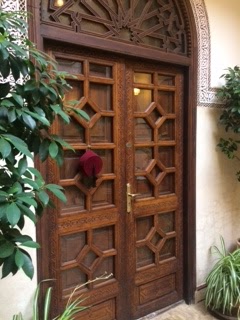
     From Casablanca Charley and I drove to Marrakesh and unloaded our luggage at the exquisite Villa des Orangers, an old French villa with a pool, library, game room, garden, small shop, and outdoor terraces for dining. Our room was similar to that in Riad Myra, consisting of a large bedroom with sofa and television and a tiled bathroom with walk-in shower and tub. The young woman who showed us to our room instructed us to put a fez (hat) on the outside of our door if we didn’t want to be disturbed!
     At poolside that evening we watched two wood storks nesting on electric poles behind the hotel.

Ceiling detail, Villa des Orangers, Marrakesh

Courtyard, Villa des Orangers, Marrakesh
     We avoided any drink that contained ice cubes and only drank liquid from bottles. We declined fresh-washed lettuce but ate the ripe, juicy tomatoes and cucumbers without a problem. Our “salads” were individual dishes of sautéed eggplant or cauliflower, stewed tomatoes, fava beans, or corn. For dinner I enjoyed chicken with figs and lemon and Charley devoured his beef with apricots and plums. Both meals had been slow-cooked in tangines with lids resembling circus tents.
     Since we were unaccustomed to the tipping mores, Rasheed stepped forward to tip whenever necessary: the toilet attendant, subjects of photos, etc. When we purchased souvenirs and arranged for delivery to our hotel, he called the shops to confirm delivery. He paid our entrance fees that had not been prearranged through his agency and bought us cold drinks from vending machines. For all this, we gave him $250 after our eight-day trip ended. After studying our guide book, we were able to use the local dirhams to tip.
Outside the Medina, Marrakesh
     The architecture of Marrakesh resembled the flat, adobe-style, red clay buildings of the American southwest. We relaxed in the Yves St. Laurent Museum (fashion, accessories, and culture of the Berbers) and among the bamboo and palms of Jardin Majorelle, owned by the late designer who had lived next door. However, I was most anxious to take a dromedary ride, offered outside the city in a Berber village. Charley declined, since he’d been on a camel in Egypt that had spit at him.

     Badis, a thirty-five-year-old father of two in bright blue robes, matching headpiece, with two overlapping front teeth, pushed me onto my high square seat atop “Madonna.”
     He assured me “Madonna” was a gentle soul. My thighs spread wide and my feet flopped without stirrups. I bumped up and down for about ten minutes, but soon was able to sit back with the gentle swaying rather than bounce in my seat. I became oblivious to the burning in my thighs. After twenty minutes, Badis handed me the reins. The poor dromedary merely followed his master, who walked beside her. The reins were really for photo ops, as this photo illustrates in silhouette.
     We plodded for an hour through acres of dirt and scrub palms toward his Berber village, wrapped behind high sand-colored walls that blended into the acreage. The only sign of life in the village was a baby crying. Rising beyond was a Club Med property and unfinished villas protruding under mechanical cranes. Water bottles, paper bags, and remnants of meals lay strewn across our trail of dirt, with water (sewage?) gurgling up in a pool far behind Badis’ Berber village.
     Motorcycles zoomed over a far hillside as we rounded the final turn of my ride. “That is my boss,” Badis said, pointing to one of the motorcyclists. Badis took almost fifty photos of me on “Madonna” using my cell phone, reminding me that he was a family man. At the end of the ride, I dismounted to join Charley and Rasheed in a café owned by Badis' boss. Badis followed, to collect his payment and his tip. The tents of the café were shredding, there was no food available (only drinks), the children’s carousel had been abandoned, and rest room faucets yielded no water. At least the toilets flushed! “The Berbers could make something of this for tourists, but they don’t care,” Rasheed said.
     We noticed in Casablanca and Rabat that buses and trolleys traversed those cities. Rasheed told us buses serviced the countryside, and a train ran from Tangiers south to Marrakesh. Below Marrakesh,  a bus ran into the desert. As we whizzed back to Casablanca on an eight-lane toll road, square sand-colored villages blended into the landscape, dwarfed by the backdrop of the High Atlas Mountains. 
     Rasheed and "Bob" walked us to our security screening area in the Casablanca airport.  Rasheed  transferred my carry-on bag to me, which he'd been pulling. He handed me his business card and hugged both of us. "Next time, call me direct," he said. "No fees for the agency!"


Read about our return to the island of Ischia, Italy, in my next blog.


Tuesday, August 6, 2019

Notes from Morocco, June, 2019, Part II

This is the second in a series based on recent travel to Morocco and the island of Ischia, Italy.


     On our second day in the city of Fez, Morocco, our guide led us through the four MILES of mysterious, mesmerizing, and overwhelming 8th-century alleyways in the Medina (market in the medieval section of the city). Passing through one of the gates, we entered a time warp, despite numerous satellite dishes on the roofs. During the four hours there, we never retraced our steps! Shafts of sunlight streamed through thatched roofs of covered stalls, donkey drivers shouted “Balek!” (“Watch out!”) while pushing overloaded mules, coppersmiths hammered, and the muezzin CD called the Muslim city to prayer. 
Scene inside the Medina, Fez

     Each section of the Medina had its own specialty: fish, poultry, meats, brass (with zinc and without), woodworking, watch repair, tailoring, fruits, nuts, vegetables, spices, fresh bread, lamps, Oriental carpets, etc., etc. The strong odor of spices yielded to curing leather or fresh fish. The shops resembled caves, with sewing machines whirring at the edge of the workshop nearest pedestrians or jewelers and electricians huddling over work tables to reassemble watches and toasters. Heads of cows, goats, and camels hung outside the shops, advertising the specialties to the illiterate populace (yes, they do eat camel). Animal brains glistened before our eyes, while chickens met their demise on the pavement inside one establishment. Goat shins and hoofs lay in a pile at our feet, forcing us to step over the blood that ran into a drain in the street. Sausages rolled from a machine behind a counter, while the proprietor tied them in loops. At a “restaurant” stall, sausages and kabobs grilled on spits, choking the alley with smoke. “This is important for the customer,” said our guide, Rasheed, pointing to a goat’s hindquarters with intact testicles hanging alongside one of the stalls. “Male meat is more desirable than female meat, and the vendor proves he’s reputable by displaying them. Shoppers can see the testicles are not sewn on!”
Olives


Butchers with sausage machine

Salads

Our guide, Rasheed, buying a snack. Yes, that's a camel's head!
     Rasheed kissed the children he passed in the alleys and bought a pair of sunglasses for a four-year-old girl he’d never seen before. “She reminds me of my granddaughter,” he said. He could have been the mayor of the Medina, receiving shouts of recognition, handshakes, and hugs all along our winding path.
     “You wouldn’t dare touch a child you didn’t know in the States,” I said.  “You would be reported.”


     We were introduced to a short, rotund, balding man in one of the alleys. “A very rich man,” Rasheed said after they embraced. “He dresses in old clothes like he lives in the Medina because he doesn’t want to be recognized. He owns two shops and a large hotel.”


  “This man makes beautiful lamps,” Rasheed said, introducing us to a proprietor seated on a stool outside a storefront along one alley. The man jumped up, shook our hands, and led us to the interior of the building where thousands of glass teardrops in every configuration hung above our heads.
     “Did you create all these beautiful lamps?” I asked him. He nodded affirmatively.
Handmade lamps

     We followed Rasheed into another narrow “cave” where a wood oven burned in a far corner. Its smoke rose through a vent in the two-foot thick walls. “This is our local bread maker,” Rasheed said. “Each family in the Medina places an order for the week.” As we watched, the baker placed flat loaves on a pan with a long handle, similar to those used for pizza in wood ovens. He brought others out of the oven and stacked them on the cement floor.


   “May I take your photo?” I asked the baker, who shook his head affirmatively. Rasheed leaned over and gave the man a few coins, as he did whenever I asked permission for a photo. The baker’s helper, probably his son, placed a number of the hot loaves in a box and took off with the order on his bike. After thanking the baker for the photo, we followed outside and were almost run over by an elderly gentleman on a motorbike. The baker’s son juggled his box and tilted sideways against the wall of the bakery to avoid a collision. A shouting match ensued, with Charley and me in the middle.
     “Calm down,” Rasheed said in Arabic to both men, which did nothing to quell their tempers. After yelling epithets at each other, they continued on their ways. We trotted behind Rasheed like puppies on leashes.
Leather or fakes?

Figs


     I mentioned to Rasheed we were hoping to find a small Oriental carpet to ship home. He led us into a two-story establishment. “If you see something you like, begin negotiations at 50%,” he said. “This is a reputable company so they won’t cheat you. The price will include shipping and tax and another carpet of lesser quality will not be substituted.” Rasheed would receive 10%, of course.
     Charley and I settled onto sofas in the large covered atrium of the store. Along the walls, beneath our feet, thrown over furniture, and hanging from the two-story ceiling were Berbers, Kilims, Kirmans, Tabrizes, You-Name-It. In a room in front of us, two women wove knots onto the fringes of small carpets. In a room behind us, a family of Americans negotiated a price for the carpet at their feet. Rasheed introduced us to the owner’s son, Abdul, who offered mint tea or bottles of water. “You speak English very well,” I said to him.
     “I attended university in the States,” he replied. I showed Abdul a photo on my phone of the Bokhara pattern and coloration we were looking for. “Follow me into this room, please,” he said. We went into another room that was bigger than any of the others. More carpets hung from wooden frames along the walls and from the ceiling.
     We settled into another sofa. In front of us two men unrolled an 8x10’ Kirman in shades of beige and blue. Not even close to what we were looking for! Next they unrolled a 6x8’ Berber in vibrant reds. Even further off! The carpets continued to get smaller and smaller the more we shook our heads. “Abdul, please look at my photo again.” After thirty minutes of sipping water and shaking our heads, a small rust, beige, and black carpet unrolled in front of us.
     “This is the finest quality silk from Uzbekistan,” Abdul said. “The weaver signed his name in the corner.” We bent over and peered at the weaver's name. The size of the carpet was perfect but the coloration a little too dark.
     “Too dark,” I said. Two men flipped the carpet over. The colors were perfect, though the weave was much flatter. “Is this the price?” I asked, looking at the tag.
     “What would you like to pay?”
     I named a price one-quarter of the Euros on the tag. “No, I can’t do that,” Abdul said. “What would you like to pay?” he repeated.
     I named a price with a 60% discount. “This is silk of the highest quality,” Abdul reasserted. We agreed on a 50% discount. “Now I want you to put your initials on the wrong side in the corner so you will know there are no substitutes from my father’s store,” he said, handing me a magic marker with permanent black ink. We told Abdul the date we would arrive home and signed the necessary paperwork. Our purchase awaited us when we got home, with my initials on the corner. When I stood over the carpet under the lights in our home, its flaws jumped out at me. I should have been more diligent in the showroom!
     “You’ll be the only one to notice,” Charley said. “Besides, they give it character.”
Our purchase in the Medina of Fez. Lighting is distorting the evenness of the coloration.

     Having completed our purchase, we continued behind Rasheed through the Medina. “Look up at that apartment building,” he said, pointing at a four-story building the color of sand. “There was an earthquake in Agadir, southwest of Fez, in 1960 that killed 1500. UNESCO provided funds to rebuild the Medinas, but look what they did with the money!” We stared at wooden struts that buttressed the rear and underpinning of the building. “Another earthquake would be a catastrophe!” he said.

     Rasheed explained that the Berbers in the country consist of Arabs, Moors, and Africans that are direct descendants of the pre-Arabs of northern Africa. Berbers total 36 million, though the nomads of the country are not counted in the census. The southern regions, where most nomads live, have been marginalized and nomad communities can be found in their original state. “It’s a different country where they exist,” Rasheed said.

     Our final stop in the Medina of Fez was the medieval tannery. Rasheed led us into a leather shop crammed with jackets, purses, hats, gloves, and traditional slippers of every color. A shopkeeper handed us a few sprigs of fresh mint to smother the smell of decaying animal flesh from the sheep, goats, cows, and camels being processed outside. We declined his suggestions for purchase, but manipulated the soft skins that felt like butter. Giving up on a sale, he led us to wooden stairs in the back of the showroom. At the top we stepped onto a terrace (Terrasse des Tanneurs) with a spectacular view of the dyeing vats. The fresh mint beneath our noses was hardly enough to deter the fetid smell.

Bleaching and tanning vats, Fez Medina

     The shopkeeper explained that at the top right in our view the skins were piled with their furs. In succession they entered concrete vats of saline, quicklime, pigeon droppings, and any of several natural dyes: poppies for red, turmeric for yellow, saffron for orange, indigo for blue, and mint for green. Barefoot workers in shorts picked up the skins from the bottoms of the vats with their feet, and worked them manually. The job was VERY well-paid and in demand for a strong export market. 

Follow our journey in my next blog through Casablanca and Marrakesh, where I had my first camel ride.

Wednesday, July 24, 2019

Notes from Morocco and Italy, June, 2019


The following is the first in a series of blogs based on recent travel to Morocco and the island of Ischia, Italy.
Royal Palace Gate, Rabat, Morocco


     Morocco sits at the rounded northwest corner of Africa, between the Atlantic Ocean to the west and the Mediterranean Sea to the north. We flew from Boston to Paris overnight and waited five hours before continuing to Casablanca on Morocco’s western coast. After another three-hour flight, our guide (Rasheed) and driver (“Bob”) met us to drive north along the coast to Rabat. We had arranged Rasheed’s and “Bob’s” services through our travel agent in the States, who had contacted a well-known agency in Morocco which she'd used previously. Rasheed was in his fifties and spoke perfect English. Both men lived in Marrakesh.
Our guide, Rasheed, with hostess at our Riad in Fez
Our driver, "Bob," pouring tea at lunch. We couldn't pronounce his Moroccan name.

     It would have been almost impossible to tour Morocco without a guide, since the country is Arabic-, Berber-, and French-speaking, and road signs and customs are often indecipherable. Both men were with us during our eight days, as we followed a circular route from Casablanca and Rabat on the northwest coast inland to Meknes, Fez, and south to Marrakesh, coastal Essaouira, and back to Casablanca. For a day trip we would enter the mid-Atlas Mountains between the northern Rifs and the southern High Atlas. We did not enter the desert to the south because of the heat in June.

     Morocco has five cities of importance: Rabat, the diplomatic and administrative capital; Casablanca, the economic capital; Fez, the intellectual, historic, and spiritual center; and Marrakesh, the tourist capital. Tangier, on the northern coast below Spain, is the shipping capital.

Walls surrounding city of Rabat and man-made lake outside King's palace

     Before leaving Rabat, we walked around government buildings and outside the primary residence of the king, King Mohammed VI, who owns thirty palaces. We continued northeast to Meknes and the Roman ruins of Volubilis in the Middle Atlas Mountains. 

Charley posing with water seller, Meknes 

Acrobat, Meknes
     Everywhere, in cities, on mountain roads, and in villages, there was construction. The following week in Casablanca we counted eight cranes in our line of vision. Apartment buildings and golf resorts were going up in areas surrounding Fez, Casablanca, and Marrakesh. Rasheed explained, “King Hassan II, our present king’s father, declared Morocco must be green and must have electricity, water, and education for its population.” I wondered how the cranes fit into the “green” mandate.

     “We pay no taxes on property here until we’ve owned for five years, so we can use the home for vacations till then but it must be unfinished. After five years, we will be taxed, so we sell.”

     Meknes is the Berber capital of Morocco (more on the Berbers in a subsequent blog). With 850,000 inhabitants, the city offered a chance to experience all the sights, sounds, and smells of Fez on a more manageable, provincial scale. The central highlands between Meknes and Fez in the Middle Atlas Mountains contain Berber villages, secret valleys, scenic woods, barren landscapes, and hilly plains blanketed with olive groves. The region can be covered in heavy snow in mid-winter.

     After touring Meknes, a guide met us outside the Roman ruins of Volubilis, the capital of the Roman province of Mauritania 2000 years ago. At its height, the capital boasted 20,000 inhabitants on twenty-eight acres. The entire city was visible on surrounding hillsides and walkable without crowds, probably because the temperature hovered around 90 F in June. Foundations of homes, ceramic tile work, and the marketplace were easily accessible, though we couldn’t step on the mosaics of private homes. We could lean backwards into the public baths and imagine Romans clearing their heads after overindulging. Wood storks nested on the remains of pillars, a hint of the hundreds we would see around the country perched on anything resembling a telephone pole.
Our guide, Aamir, in Roman ruins of Volubilis

Wood stork nest in Volubilis
   
Our guide demonstrates how Romans cleared their heads after overindulging

Mosaics on the floor of a private home, Volubilis
  
Street where our Riad Myra was located in Fez
     From Volubilis we drove northwest to Fez, a UNESCO World Heritage Site (along with Meknes). A city of 1,000,000 inhabitants, Fez is the Arab capital of Morocco, divided into two parts:  the 8th Century labyrinth of the Medina behind its stone walls with two historic sections, Fez el-Bali (Old) and Fez el-Djedid  (New); and Ville Nouvelle, the “New Town.” Morocco declared independence from the French in 1956 after forty-four years, but remnants of the French language and architecture are still evident. We walked through a winding alley (street) with multiple closed doorways announcing commercial establishments, finally arriving at the Riad Myra (restored 16th -century palace built around a courtyard with flora, fountains, and hammam – ritual steam bath). We stepped through the wooden framework of an over-sized door into a structure that filled almost an entire block. In the center was a two-story covered atrium. Guest rooms ran around the perimeter of each floor, surrounded by pierced plaster and laser-cut metal fretwork. 
Our room (left) on 2nd floor of Riad Myra in Fez

Mint tea or lemonade at Riad Myra

The door to our room
Detail of tile and fretwork on the wall of our room, Riad Myra, Fez
     We got settled in our room (“La Favorite”) on the second floor and went down to relax on sofas in the central courtyard for drinks. For dinner the hotel staff served us chicken shish kebabs on skewers and slow-cooked vegetables from circus-tented terrines. An apple tarte tatin appeared for dessert, along with delicious mint tea that followed every meal. Even Charley switched from Coke Zero to tea!


View of four square miles of Medina (Old City) of Fez 

Medina of Fez below, with Ville Nouvelle on upper plateau


Read about our adventures in the medieval Medina of Fez in my next blog.

Wednesday, May 29, 2019

Condo Living


     Charley recently received a call from one of the two condos on our first floor. The woman had been our association president a few years back. "Charley, I want to mention a problem in the front entrance of our building," she said.
     "Oh, what is it?"
     "Well, the wooden frames of the two upholstered chairs inside the front door are knocking against the wallpaper and it might have to be replaced. Someone keeps tilting the chairs inward toward the stairs. They should remain straight."
     "Why are you telling me this?"
     "Carmen (a member of the staff) tells me you walk every other day and use the main entrance."
     "I do walk but I don't touch the chairs. I wouldn't dare! Isn't there a chair rail along the wall?"
     "Yes, but the chairs seem to rub against the wallpaper anyway. The backs of the chairs curve outward above the chair rail. I thought since you're coming back on the Board of Directors, you should be made aware of the problem. Every time I go out my door I straighten them if they're tilted."
     "Well, thanks for the heads-up. I'll make sure I don't go anywhere near the chairs."
     Charley then informed me of the call.
     "I'm the one pulling the chairs out from the wall and tilting them, but don't tell Dolores," I said. "The decorator placed them that way so they wouldn't block the door and besides, they're farther away from the wall when they're tilted. When they're straight, the backs are more likely to hit the wall."
     "Just don't touch them again and I won't tell her," Charley said.
     I wasn't about to let the CHAIR NAZI lecture me! After all, I had owned a design company for almost fifteen years and had seen Dolores' apartment, which was stuck in the seventies.
     The next time I went to the pool I checked to make sure Dolores' car was gone. Then I tilted the two chairs.
     The cat-and-mouse game continued. The chairs were straight against the wall when we went out to dinner.
     The following week I noticed the chairs were tilted away from the wall. I hadn't played the game that week, but someone else had taken up the cause! I figured it had to be the new guy on the maintenance staff, who wanted to enter the building without bumping into anything. I exited the game, knowing it was in good hands.
     The next week I went to the pool and discovered one chair straight against the wall and one chair tilted inside the front door. Someone had a bad case of schizophrenia!
     When we left Florida to go north for the summer, the chairs were in the opposite positions, one straight in front of the door and one tilted on the other side. I love condo living!


Tuesday, May 14, 2019

Support Hose

     Do you have sore or tired legs? Recently had a surgical procedure on your legs?
     Then compression hose are for you!
     They come in full or knee-length, different sizes according to your height, and either dress, athletic, or casual styles.
     There's only one problem: getting them on!
     I recently had a minor surgical procedure done above one knee. Since companies don't make support hose for single legs, Laurie, the doctor's assistant, asked what my height was. After I told her, she returned with a pair of skin-toned compression stockings and some thin rubber gloves.
     "These should fit," she said, "They're casual, and not too thick. Please wear them for two days, but take them off at night." She had a smirk on her face.
     The stockings looked like Pantyhose, with the standard construction of a strong elastic band at the waist and nylon covering the hips and buttocks thicker than the leg portion. If these were the thinnest variety, I pictured the thicker ones resembling an alligator's skin. "What are the gloves for?" I asked.
     "You'll see. First, sit down on the examining table so I can help." She handed me the gloves to put on, put another pair on herself, and sat on a low stool at my feet.
     "Many patients think this is just like putting on Pantyhose. It's not. The first thing you do is scrunch up the hose in your hands all the way down to the ankle. That way you can put your foot in without getting it caught."
     She handed me one scrunched-up leg. The flesh-colored nylon that filled my entire hand was at least three times the thickness of a Pantyhose. I slipped it over my foot.  So far, so good!
     "OK, now pull the hose up about six inches. It's much thicker than Pantyhose, so don't expect it to go farther than that. You'll have to straighten it every few inches. The gloves will let you get a firm grip." From the floor she helped the hose go north of my ankle. "You try the rest of the leg."
     The opening for my upper thigh was about the size of my fist. "Are you serious? I have to put that over my thigh? I feel like an elephant trying to get into a pail."
     "Keep working every few inches."
     At first I pulled so hard I thought the stuff was going to rip. Then I jumped down from the table and twisted. I squirmed. I thrashed. I got the damned nylon up to the middle of my thigh but by then sweat was dripping into my eyes so I couldn't see. Laurie was trying to stifle her laughter. She handed me some paper towels.
     "It is pretty funny," I said, sitting back down on the examining table. "I felt a twinge in my abdomen. Maybe I pulled a muscle there I didn't know I had!" The stocking was binding my thigh like a lasso pulled tight. "Maybe I've got some blog material here." I began to laugh with her.
     "Now the other leg," Laurie said. She left me on my own for that one.
     "Can I try it without the glove?" I asked, thinking I'd get a better grip with my very sweaty hands. It felt as if my first leg had a tourniquet around it. I began to feel pins and needles creeping along the seam and looked down to make sure the leg wasn't turning purple.
     "Sure, go ahead," she said.
     I removed the gloves and held them upside down. They dripped moisture as though I'd used them in a tennis match. I scrunched up the other leg all the way down and tried to put the wad over my foot. My hands slipped and my foot got caught half-way up the wad. So much for bare hands! I put the gloves back on, got my second foot in, and jumped down from the table.
     At mid-thigh level on the second leg, I felt as if I'd played three sets of hard tennis. "There's no way the rest of me is going into this opening," I said to Laurie, holding open the elastic that was supposed to go around my waist.
     She just kept grinning from the floor. "Just a few inches at a time," she said.
     My hips weren't the problem. It was my butt. I've never had a small butt, even when I was twelve years old. It's a wonder I was able to get off the ground during all the years I was a cheerleader! You would think the exercises I've done for years at the fitness center and all the tennis I play would have made it smaller.
     I began to do the twist, pulling the nylon over my butt first on the right side, then on the left. Laurie clapped from the floor. Next I pulled up the waistband and jumped up and down. Too bad I couldn't get a few jumping jacks in, but I'd had enough exercise for one day. "Just a few more inches," she said. "Maybe your husband can help you tomorrow."
     That sent me flopping back on the table in hysterics as I pictured Charley stuffing me into a sausage casing from the floor. "Are you sure I can't leave them on tonight?" I asked.
     "Trust me. You won't want to!"


Monday, April 15, 2019

The Joy of Lifetime Friendships

     Last month five of my high school girlfriends visited me in Florida. Previously, we'd reunited in Massachusetts before the 50th class reunion. We'd also stayed at an inn in Greenwich, Conn., prior to the 55th.
     Marilyn was my best friend from elementary through high school. Our mothers were Girl Scout leaders together; we rode bikes to Tod's Point Beach and had sleep-overs on weekends; at age sixteen we were camp counselors in Litchfield, Connecticut, together. After high school I headed to college in Maine and she to Ohio. Subsequently, we were in each other's weddings and got together sporadically when in the area. Charley and I visited her daughter and family in Italy and I attended her husband Wayne's memorial service in Ohio.
Pam and Marilyn, 2013
     In 1995 Charley and I sat in the wooden stands at a "AA" Red Sox game in New Britain, Connecticut. Our son Todd was on the team. After several innings listening to the conversation between the husband and wife seated a few feet from me, I sheepishly asked, "Are you Cindi King?" It was a high school classmate, the captain of my cheer-leading squad, and her husband, the captain of the ice hockey team.
Greenwich (Ct.) High School Hockey Team, 1960

     During that first girlfriend gathering in Massachusetts all of us were tentative with each other.  We talked of parents and siblings we all knew. Over bottles of wine we broke out our high school yearbooks to reminisce about proms and boyfriends, our favorite teachers, college weekends our parents consented to, and cheer-leading uniforms we paraded in. We had shared the trivialities of the teen years through quasi-adulthood. During walks on the beach we felt each other out to reveal medical problems, failed marriages, and worries over kids.
Westport, Mass., 2011
2011
     Over time we've relaxed with each other. There are no longer any pretenses. We know each other's family secrets. At our latest gathering, we made no excuses if we needed to run to the bathroom at the last minute or keep our slacks on when headed to the pool. We knew the traumas each had suffered and we'd been there, physically or emotionally, despite great distances.
Delray Beach, Florida, 2019
     Science has begun to show the value of close friendships on health. One study of over 3,000 nurses with breast cancer found that women without close friends were four times as likely to die from the disease as women with ten or more friends. The study found that it wasn't the number of interactions or amount of contact that mattered. Simply having the friendships to protect from stress was enough. This may be one of the reasons women live longer than men. (Information from Tracey O'Shaughnessy's "Lifetime Friendships Are Something to Envy," The Sunday Republican, December 23, 2018, p. 1E).
Wakodahatchee Wetlands, Delray Beach, Fl., 2019
     During our group's good humor and reliving of shared experiences, there was a nurturing element in familiarity. We basked in the glow of each other's caring but felt enriched by our own capacity to express that kindness. The Benedictine nun Joan Chittister wrote in The Friendship of Women, "Friendship reminds us that we are irreplaceable, vital to a life beyond our own. Once we are loved, we have an obligation to live as best we can."
Pam with Pat, Mystic, Conn., 2017
Delray Beach, Fl., 2019
     What of our grandchildren, who claim hundreds of "friends" on the internet and may spend up to nine hours a day online, including homework and playing games with a bot (artificial intelligence)? Thirty-two percent of tech professionals, according to Stephen Asma in "This Friendship Has Been Digitized" (NY Times, March 24, 2019, Sunday Review, pg. 10), now believe digital life will harm our mental well-being over the next decade. Recent research suggests that isolation is increasing, as intimacy among teens is replaced by texting and other forms of digital communication.
     Young people, however, don't seem to be concerned. They feel socially supported by large networks of "friends" they never see face-to-face. The kind of presence required for deep friendships does not seem cultivated in on-line relationships. There we cannot touch or smell each other, detect each other's facial expressions, or moods. We can easily replace on-line "friends" and often don't know where they live or if they're a he, she, or bot. For the disabled, however, that is an advantage.
     Asma in his article proclaims the most defining feature of deep friendship is "doing for," as when a person is sick and needs soup or a ride for medicine or appointments. "The emotional entanglement of real friendship produces oxytocin and endorphins in the brains and bodies of friends - cementing them together in ways that are more profound than other relationships."
     Kids still get a large amount of face-to-face time in school and after-school. However, when Professor Asma asked his college students if they had people in their lives who would bring them soup when they got sick, they laughed. They told him they'd order from UberEats!
The Breakers Hotel, Palm Beach, Fl., 2019


Monday, April 1, 2019

Raising a Royal To Be "Normal"

     Is it even possible to raise a British royal child as a "normal" person?   
     According to a Vogue Daily on-line report (March 26, '19), Prince Harry and Meghan Markle will raise their first-born differently from previous royals.
     The nursery will have vegan paint, eco-friendly products, and, according to People magazine, the duchess will "probably make her own baby food." She is considering hiring a doula (someone who provides emotional and physical support during birth) and will focus on "calm and positive energy around the birth."
     A source told E!News that "Meghan is also keen for her child to be fully aware of his or her American heritage." This may translate into sending the child to an American school, one of which is located not too far from the couple's new home of Frogmore Cottage in Windsor.
     The pair is considering a "manny," or a male nanny. Per a source in The Sun, Meghan "is keen to introduce the royal family to what she considers a more enlightened, modern American" (who must be bi-lingual because Meghan speaks Spanish and is picking up French).
     What about the child's title? "The Duke and Duchess of Sussex will not seek any official royal role for their first child," according to The (London) Times in October, and may forego a title.
     Does this make a royal child "normal" in a house that is now undergoing a $2.5-$3.8 million renovation (which will include a Scarlet O'Hara double staircase, yoga studio, all new fireplaces, five bedrooms, and soundproofing, among other things)? Based on the life Meghan is living prior to the child's arrival, it's doubtful.
     Meghan's baby shower was held in New York City in a 10,000-square-foot penthouse in the five-star Mark Hotel. Guests included Serena Williams, Gayle King, and Amal Clooney, who received leather tote bags retailing around $200, as did all the guests. The totes were filled with a designer candle, designer body butter, rice enzyme powder, and Honest Beauty products (company founded by Jessica Alba), also known for natural baby products. When the guests departed, they received Away suitcases, retailing for $225-$295.
     I don't remember receiving favors from baby showers that weren't a candle, a fake flower arrangement, or a picture frame (presumably for the new baby's photo)!
     The guests at the Markle shower participated in a group activity. Under the direction of a professional florist, each guest made an individual vase. The arrangements were then donated to Repeat Roses, which delivers to hospices, homeless shelters, and treatment centers like the Ronald McDonald House.
     Let us hope the new baby will be raised in this spirit of charity and will at some point actually visit a Ronald McDonald House.